
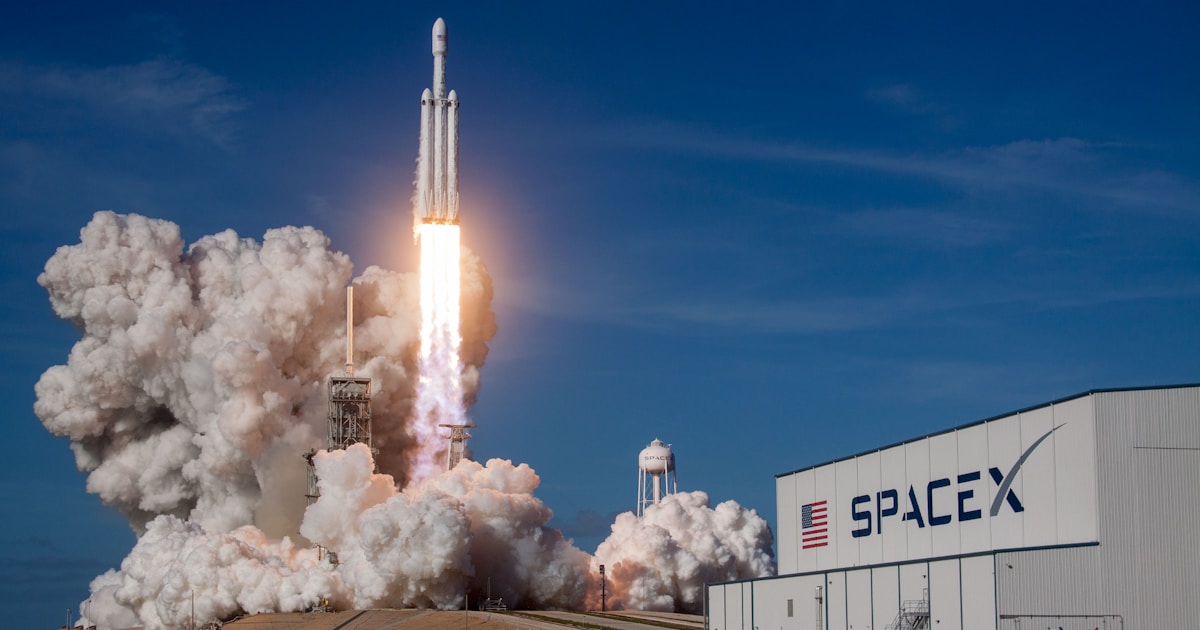
Shares of Space Exploration Technologies Corp. (Nasdaq: SPCX) closed at $192.50 on Monday, June 15, 2026, up 19.6% on the day and roughly 42.6% above the $135 IPO price set just last week. The move pushes SpaceX’s market capitalization to about $2.52 trillion, vaulting it past Tesla and into the top five most valuable US-listed companies less than three trading days after its debut.
Volume hit 243.8 million shares — among the heaviest in any newly listed name on record — and the stock kept climbing in after-hours trade, last printing $214.12, up another 11.2%. Multiple brokers reported that retail allocations cleared inside the first hour, and at least one tokenized-equity venue said it routed $1.4 billion of SPCX-linked transactions over the weekend.
From $135 to a top-5 US stock in three sessions
The IPO itself, priced last Thursday, was already historic: a $75 billion base raise (up to $86.25 billion with the greenshoe) at a $1.75T implied equity value, structured as a fixed-price deal led by Goldman Sachs and Morgan Stanley, with an unusual 30% retail allocation against the typical 5%. (See our earlier coverage: SpaceX Prices Biggest IPO Ever at $135.) The post-IPO repricing has now layered another ~$770 billion of market cap on top of that already record-setting deal.
The scale is easier to grasp against incumbents. SPCX is now larger than Tesla and Berkshire Hathaway on a market-cap basis, behind only Apple, Microsoft, NVIDIA, and Alphabet among US-listed equities.
| Company | Price | Market Cap | TTM Revenue | P/Sales |
|---|---|---|---|---|
| Apple (AAPL) | $296.42 | $4.35T | $451.4B | 9.6x |
| SpaceX (SPCX) | $192.50 | $2.52T | $19.3B | ~131x |
| Tesla (TSLA) | $411.15 | $1.54T | ~$96B | ~16x |
At ~131x trailing sales, SPCX is now the richest-multiple US mega-cap by a wide margin. Apple trades near 10x sales, NVIDIA near 30x at recent prints, Tesla around 16x. For context, even at the peak of the 2021 cloud-software bubble, only a handful of names sustained P/S multiples above 50x — and most halved within two years.
Why the stock kept going
Three things drove the post-IPO surge:
- Scarcity of float. The 30%-retail allocation cleared inside the first hour, but institutional demand from index-tracking and growth funds is only now ramping. SPCX is not yet in the S&P 500 (the standard six-to-twelve-month seasoning rule applies), but several actively managed funds began bidding into the open.
- Sympathy buying across the SpaceX complex. Tokenized SpaceX shares traded on Bitwise’s USCC product and Bullish-platform synthetic listings rallied alongside the cash equity, and crypto venues reported $1.4B in SPCX-linked turnover over the weekend.
- Starlink narrative reset. Several sell-side desks rebuilt their sum-of-the-parts models post-IPO using disclosed subscriber and ARPU figures, lifting their Starlink-segment NPVs and pulling the consensus price target higher.
The bear case is just as loud
Wall Street’s consensus price target sits at $164 — about 15% below Monday’s close — and the most prominent bear has the stock at $115, implying ~40% downside. The bear argument is straightforward: SpaceX reported $19.3 billion in trailing revenue with a negative ~45% operating margin, meaning the company is still burning cash to fund Starship development, second-generation Starlink satellites, and the Grok-AI build-out under its newly disclosed AI segment. At $2.5T of equity value, the stock is pricing in flawless execution across all three segments — launch, broadband, and AI — for the next decade.
What to watch from here
Three near-term catalysts are likely to set the next leg of the price:
- Lock-up and greenshoe. The 25-bank syndicate has up to 30 days to exercise the $11.25B greenshoe, which would add 83.3M shares to the float and could pressure the stock if exercised at current levels. The first insider lock-up expires 180 days post-IPO (mid-December 2026); a secondary follow-on within the first year is on the table given the run-rate cash burn.
- First quarterly print. SpaceX will report Q3 2026 as a public company — its first as a listed entity — likely in early November. The Street will be looking for Starlink ARPU and net-add disclosures, Starship cadence, and any guidance framework. Even a modest miss on Starlink subs could compress the multiple sharply.
- Index inclusion mechanics. The S&P 500 requires four consecutive quarters of profitability before inclusion, which SpaceX will not meet for at least 12-18 months. Russell 1000 add at the June 2027 reconstitution is the more realistic first index event. Until then, passive bid is absent and demand is purely active.
Bottom line
The first three sessions of SPCX have followed the well-known pattern of richly valued, retail-led IPO debuts: a fixed-price deal that was already historically large has now been re-rated by another ~$770 billion of market cap on heavy volume, with the move concentrated in retail and crypto-tokenized venues rather than traditional institutional flow. The market has effectively repriced SpaceX from $1.75T to $2.5T in 72 hours — and the gap between the stock and the sell-side consensus target ($164) has widened to roughly 15%. Whether the after-hours $214 print extends or fades on Tuesday’s open will be the cleanest read on whether the retail bid has more left to give.
Sources
- Yahoo Finance quote pages: SPCX, AAPL, TSLA (intraday, close June 15, 2026)
- ECMSource prior coverage: SpaceX Prices Biggest IPO Ever at $135 — SPCX Debuts Today
- S&P Dow Jones Indices methodology — eligibility criteria for the S&P 500: S&P 500 index methodology
- FTSE Russell — Russell US index reconstitution schedule: Russell US Indexes
Disclosure: It is for informational purposes only and is not investment advice.