
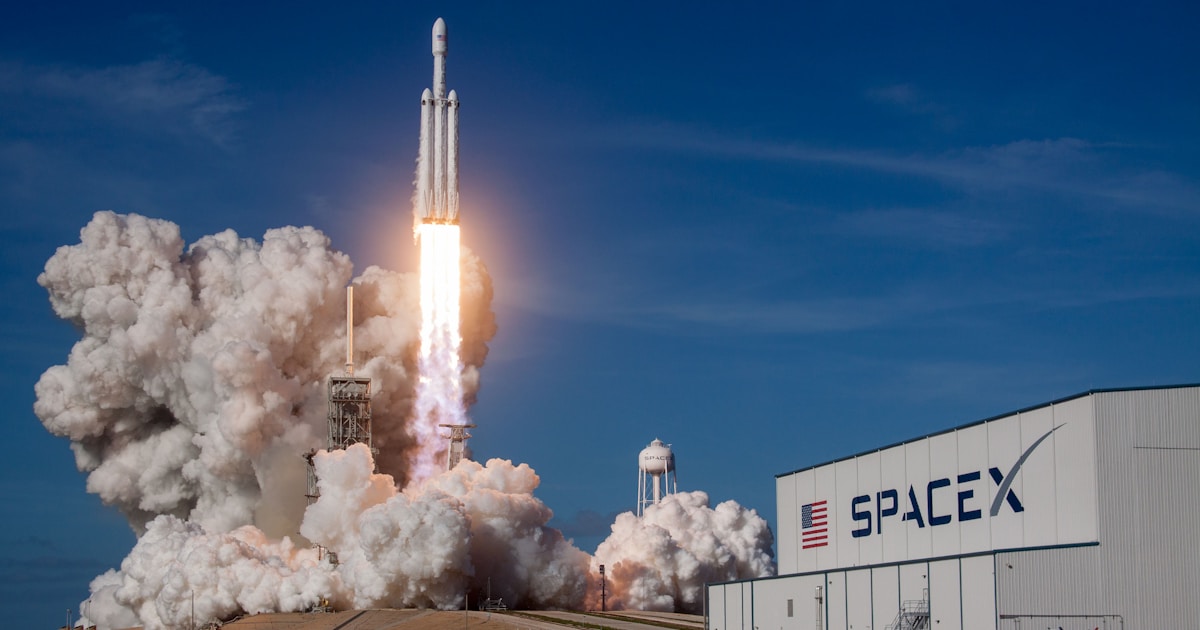
SpaceX priced its initial public offering at a fixed $135 per share after the close on June 11, 2026, and Class A common stock begins trading on Nasdaq today under the ticker SPCX. At the base size of 555,555,555 shares, the deal raises roughly $75 billion at an implied equity value of about $1.75 trillion. A 30-day underwriter over-allotment option of an additional 83,333,333 shares — the “greenshoe” — can lift total proceeds by another $11.25 billion if fully exercised. Yahoo Finance reported the price set ahead of the Friday Nasdaq debut.
The order book closed roughly two times covered at the base size, with reported demand of about $150 billion against the $75 billion deal. Even at that more conservative figure, this is the largest IPO in history by a wide margin — nearly three times Saudi Aramco’s $25.6 billion 2019 listing in nominal proceeds and almost a clean triple of Alibaba’s 2014 New York debut.
The price is fixed, and that matters
Most large IPOs run a multi-day bookbuilding process: underwriters publish a price range in the preliminary prospectus, take orders from institutions, gauge demand, and set a final price the night before trading begins. SpaceX did the opposite. The roadshow opened with a fixed $135 indication already in place. Investors could subscribe at that level or step aside — there was no upward price discovery during marketing.
That structure is rare at this scale and has two consequences. First, it locks in the issuer’s proceeds with no upside if demand was stronger than $150 billion suggests. Second, because the offer price did not move with the book, the entire question of “mispricing” gets pushed into the open. If SPCX prints sharply above $135 on the tape today, the seller community will note that the issuer left value on the table; if it trades poorly, the same community will conclude the book was thinner than the cover ratio implied.
How the SpaceX deal stacks up to history
| IPO | Year | Base proceeds (USD bn) | Implied equity value (USD bn) | Exchange |
|---|---|---|---|---|
| SpaceX (SPCX) | 2026 | ~75.0 | ~1,750 | Nasdaq |
| Saudi Aramco | 2019 | 25.6 | ~1,700 | Tadawul |
| Alibaba | 2014 | 21.8 | ~168 | NYSE |
| AIA Group | 2010 | 20.5 | ~30 | HKEX |
| Visa | 2008 | 17.9 | ~44 | NYSE |
| ICBC | 2006 | 19.1 | ~140 | HKEX/SSE |
Retail gets 30% — six times the usual cut
The other unusual feature is the allocation. Underwriters typically reserve around 5% of an IPO for retail brokerage channels, with the bulk going to long-only institutions, hedge funds, and sovereign accounts. On SpaceX, the syndicate is steering up to 30% of the base offering to retail, distributed through Charles Schwab, Morgan Stanley’s E*Trade, and Robinhood. At a $75 billion base, that is roughly $22.5 billion of paper handed to individual brokerage accounts — an absolute dollar figure with no real precedent.
The reasoning is partly political and partly mechanical. Politically, a deal this large and this iconic invites uncomfortable headlines if everyday investors are locked out while institutions flip pops. Mechanically, individual buyers are statistically less price-sensitive on opening prints than crossover hedge funds, which makes them useful ballast for a fixed-price book of this size. Critics worry the same retail base will be a less stable holder if the stock breaks materially below $135.
Goldman lead-left, Morgan Stanley joint, plus a 20-bank syndicate
The underwriting league table reads the way you would expect for a deal of this profile. Goldman Sachs took the coveted lead-left position, with Morgan Stanley as joint lead and Bank of America, Citigroup, and JPMorgan Chase rounding out the bulge-bracket. Roughly 16 additional banks fill out the syndicate. SpaceX is reported to have driven a hard fee bargain, accepting an underwriting spread well below the IPO industry standard — a concession the banks accepted in exchange for league-table credit and downstream wealth-management economics.
The Warren letter and post-listing risk
Senator Elizabeth Warren wrote to the SEC on the eve of pricing asking the regulator to delay the offering, citing concerns about investor protection, governance, and the prospect of fast index inclusion forcing passive funds to absorb mechanical buying at a valuation she described as untested by public-market scrutiny. The SEC did not act on the request before pricing.
Index inclusion is the immediate technical question. If SpaceX qualifies for the S&P 500 on the standard size-and-liquidity tests after a seasoning period, passive funds tracking the index would be required to add the stock at whatever the prevailing price is on inclusion day — a known mechanical bid that has historically moved newly added names meaningfully into the rebalance. That dynamic, more than any first-day pop, is what active investors are watching.
The bottom line
The largest IPO in history pricing at a fixed level, with a 30% retail allocation, an oversubscribed-but-not-blowout book, and a regulatory letter still on the table, makes today’s SPCX tape a real-time stress test of the new-issue market. Most of the dollars are already placed. What is being priced this morning is the rest of the float and the next four weeks of follow-on trading — and that is where the work of valuing a $1.75 trillion company in public hands actually begins.
Sources
- Yahoo Finance — SpaceX sets $135 IPO price ahead of Friday Nasdaq debut
- CNBC — SpaceX targets fixed $135 IPO price for roadshow (Jun 3, 2026)
- CNBC — SpaceX picks Goldman Sachs for lead-left position (May 19, 2026)
- Seeking Alpha — SpaceX eyes $75B IPO at record $1.75T with greenshoe option
- Motley Fool — SpaceX’s historic IPO may be oversubscribed (Jun 9, 2026)
- EBC — SPCX retail allocation explainer
- Inc. — What is a greenshoe option
- SEC EDGAR — Space Exploration Technologies Corp. Form S-1
- Investing.com — Warren SEC letter, valuation risk
Disclosure: It is for informational purposes only and is not investment advice.