
Space Exploration Technologies Corp. — SpaceX — formally filed its S-1 registration statement with the SEC on May 20, 2026, opening the door to what would likely be the largest initial public offering in U.S. history. The filing confirms the proposed ticker SPCX, a dual listing on Nasdaq and the newly launched Nasdaq Texas, and a dual-class share structure designed to keep founder Elon Musk firmly in control after the offering.
Within days of the filing, public-company comps in the space sector caught a sympathy bid: Intuitive Machines (LUNR) traded up double digits, Virgin Galactic (SPCE) jumped 17.8% on May 22, and Rocket Lab (RKLB) extended its multi-month uptrend. The S-1, however, is the main event — it is the first time SpaceX has put audited segment financials in front of the public, and the numbers redraw what the market thought it knew about the company.
The Filing in Numbers
SpaceX reported FY2025 consolidated revenue of $18.674 billion, up 33% year-over-year, with a loss from operations of $(2.589) billion and Adjusted EBITDA of $6.584 billion. For the first quarter of 2026, revenue was $4.694 billion, up 15% versus Q1 2025, with Adjusted EBITDA of $1.127 billion. The placeholder offering amount in the filing-fees exhibit is $1 billion — a routine SEC placeholder, not the actual deal size, which will be set during bookbuilding.
| Segment | FY2025 Revenue | YoY Growth | Segment Adj. EBITDA | What It Is |
|---|---|---|---|---|
| Connectivity | $11,387M | +49% | $7,168M | Starlink consumer, enterprise, mobile, government |
| Space | $3,257M | +7% | $2,087M | Falcon, Dragon, Starship launch & development |
| AI | $3,201M | +22% | $(1,237)M | X (Twitter), Grok, xAI, data licensing |
| Consolidated | $18,674M | +33% | $6,584M | Three reportable segments combined |
Three takeaways from the segment table stand out. First, Starlink — sitting inside the Connectivity segment — is now the largest revenue line by a wide margin, and it is also the largest profit pool, contributing $7.168 billion in segment Adjusted EBITDA on $11.387 billion of revenue. Second, the Space segment (Falcon, Dragon, Starship) is smaller than many investors assumed and is growing in the single digits — its job inside the model is to launch the satellites and earn high incremental margin on each manifest slot, not to be the headline growth engine. Third, the AI segment — which consolidates X (Twitter), Grok, xAI compute, and data-licensing revenue — generated $3.2 billion of revenue but lost $(1.237) billion of segment Adjusted EBITDA, reflecting heavy R&D and infrastructure spend.
The Launch Engine
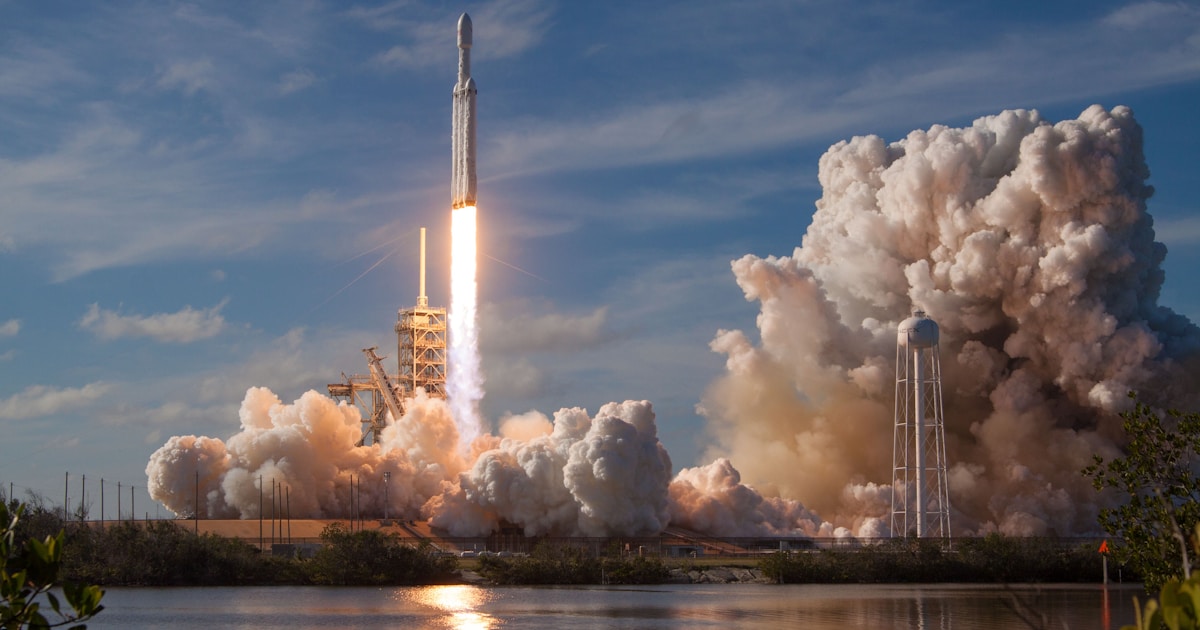
The S-1 also discloses operating cadence that is hard to find elsewhere. Total Falcon launches rose from 96 in 2023 to 134 in 2024, a 40% increase in cadence year-over-year, with reusability driving down per-launch depreciation. The Starship program — the next-generation, fully reusable super-heavy lift vehicle — is positioned in the filing as the critical bridge to deploying V3 Starlink satellites, V2 satellite-to-mobile connectivity, and an orbital AI-compute layer that SpaceX is now publicly disclosing as a growth vector.
Deferred revenue — the backlog of customer commitments not yet recognized — sat at $13.236 billion as of March 31, 2026, up from $12.116 billion at year-end 2025. That figure is roughly two-thirds of trailing-12-month revenue and gives the Space segment in particular a multi-year visibility curve that few aerospace companies can match.
Dual-Class Control
The capital-stock section will draw scrutiny from governance-focused investors. The structure is dual-class: Class A common stock, the IPO security, carries one vote per share; Class B common stock, held by Musk and a small group of insiders, carries 10 votes per share. Class B shareholders also have the right to elect a majority of the board. The S-1 is explicit that Mr. Musk “will be able to control the outcome of matters requiring shareholder approval,” including the election of Class B directors, “for so long as” he retains the relevant Class B holdings.
That governance profile is similar in spirit to Alphabet’s GOOG/GOOGL structure and Meta’s Class B super-voting shares — common among founder-led tech IPOs but a point of friction for index providers and certain pension funds whose mandates restrict ownership of low-vote share classes.
Why the Nasdaq Texas Listing Matters
SpaceX is incorporated in Texas and headquartered in Starbase. The S-1 confirms the company has applied to list its Class A common stock on both The Nasdaq Stock Market LLC and Nasdaq Texas, Inc., a dual-venue choice that reinforces SpaceX’s identity as a Texas company after its reincorporation away from Delaware. It also makes the IPO one of the highest-profile filings to use the new Texas listing venue.
What to Watch From Here
An S-1 filing is the beginning of the IPO process, not the end. From here, SpaceX will respond to SEC comment letters, file amendments (S-1/A), set a price range, embark on a roadshow, and then price the deal. The market will be watching three things in particular:
- The price range and valuation: Recent secondary-market trades reportedly valued SpaceX at around $800 billion in 2025, and bankers were reported to be modeling a $1 trillion+ market cap at IPO — but the official range will only appear in a later amendment.
- Use of proceeds: The current filing has a placeholder; the priorities (Starship, V3 satellites, AI compute, debt paydown) will shape how investors model the next three years.
- Lock-ups and Class B mechanics: When existing holders can sell, and under what conditions Class B converts to Class A, will drive both the float math and the long-run governance trajectory.
For now, the document itself is the story. After more than two decades as the most-watched private company in technology, SpaceX has put its books on the public record — and the rest of the space sector is repricing accordingly.
Disclosure: It is for informational purposes only and is not investment advice.
Sources
- SEC EDGAR: Space Exploration Technologies Corp. Form S-1 (filed May 20, 2026)
- SEC EDGAR: SpaceX S-1 Filing Fees Exhibit (Form EX-FILING FEES)
- SEC EDGAR: SpaceX (CIK 0001181412) Filing History
- SpaceX corporate background and prior valuation context
- Yahoo Finance: Intuitive Machines (LUNR) — sympathy move in space stocks