
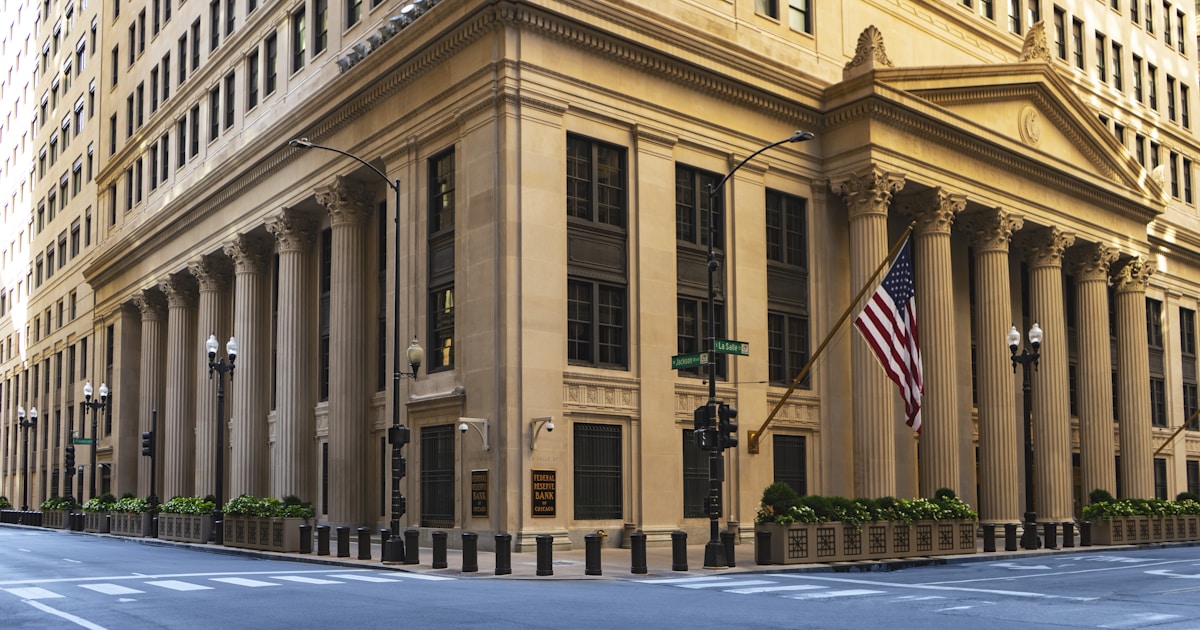
The Federal Reserve held its benchmark interest rate at 3.5% to 3.75% for the third consecutive meeting on April 29 — and bond markets registered the news with a selloff. The 10-year Treasury yield is hovering near its 2026 high of nearly 5.0%, the 30-year bond briefly crossed 5%, and bond market pricing now reflects no rate cut until at least late 2027, according to Barron’s. That is a dramatic shift from expectations held earlier this year and a meaningful increase in long-term borrowing costs across capital markets.
Three Straight Holds — and a Divided Committee
The Federal Open Market Committee (FOMC) voted to keep the federal funds target range at 3.5% to 3.75% at its April 29 meeting — the third identical decision following holds on January 28 and March 18, 2026.
The April 29 vote was far from unanimous. Four of the twelve voting FOMC members dissented. Stephen Miran voted for an immediate quarter-point cut, citing labor market softening. Three others — Neel Kashkari, Beth Hammack, and Lorie Logan — voted to hold but objected to any policy language that even hinted at future rate cuts, fearing markets would prematurely price in easier conditions.
The split reveals the depth of uncertainty inside the Fed. The April 29 statement noted that “Developments in the Middle East are contributing to a high level of uncertainty about the economic outlook,” with geopolitical risks continuing to weigh on energy prices and inflation dynamics.
Musalem Reinforces the Hold — May 6
St. Louis Federal Reserve President Alberto Musalem added fresh emphasis on May 6, stating publicly that the central bank would need to maintain current interest rates “for some time” before any adjustment. Musalem said he was more concerned about inflation overshooting than about near-term employment weakness — aligning with the hawkish dissents from Kashkari, Hammack, and Logan.
A notable political shift also emerged in late April, when Barron’s reported that the White House appeared increasingly open to a prolonged rate pause. If the administration has moved away from pushing for rate cuts, political pressure on the Fed to ease has diminished — giving policymakers more room to hold without external friction.
A Yield Curve Under Pressure
Long-term Treasury yields have moved substantially higher since January 2026. The 10-year yield is up 6.80% year-to-date, sitting at 4.45% and within striking distance of its 52-week high of 4.997%. The 30-year bond recently crossed 5% before pulling back to 4.95%, a level still well above its 52-week low of 3.72%.
The 3-month Treasury bill, anchored near the federal funds rate, has remained near 3.60%. The resulting spread between short and long maturities — roughly 85 basis points between the 3-month bill and the 10-year note — represents a meaningfully upward-sloping yield curve, a sharp reversal from the yield curve inversion that persisted through much of 2022–2024.
| Maturity | Yield (%) | YTD Change | 52-Week High |
|---|---|---|---|
| 3-Month T-Bill | 3.60% | ~0% | — |
| 5-Year T-Note | 3.99% | +7.28% | — |
| 10-Year T-Note | 4.45% | +6.80% | 4.997% |
| 30-Year T-Bond | 4.95% | +2.17% | 5.152% |
| Fed Funds (midpoint) | 3.625% | — | — |
YTD Yield Moves: Where the Pressure Is Concentrated
Year-to-date yield changes reveal where borrowing cost pressures are most acute. The 5-year and 10-year maturities — the core of corporate bond pricing — have risen over 6–7% from their January levels, outpacing the 30-year’s more modest 2.2% gain. The 3-month bill has been essentially flat, pinned by the Fed’s unchanged target range. This concentration of yield increases in the belly and intermediate segment of the curve is where most investment-grade corporate issuance is priced, and where refinancing costs for businesses have risen most.
What Higher Yields Cost Capital Markets
Every basis point that long-term yields hold higher raises the cost of capital for businesses, governments, and households. The transmission to capital markets is direct and broad.
Corporate debt issuance: Investment-grade companies that locked in sub-4% rates in 2021–2023 now face refinancing at materially higher costs. With the 10-year at 4.45% and typical IG credit spreads above the risk-free benchmark, new 10-year corporate bonds are pricing in the 5–6% range for most borrowers. For leveraged companies and private equity-backed firms — many of which borrowed at floating rates tied to SOFR, which tracks the federal funds rate closely — refinancing risk is most acute.
Private credit and leveraged loans: The Fed’s extended pause keeps short-term benchmarks elevated. Private credit funds deployed capital during the post-hike plateau and now compete on spread with broadly syndicated loan markets. Borrowers face limited relief from any near-term easing: the short end stays anchored while the intermediate portion of the curve has moved materially higher.
Real estate and infrastructure debt: Long-duration assets are valued by discounting future cash flows against long-term interest rates. With the 30-year Treasury at 4.95% and having recently crossed 5%, commercial real estate refinancing remains under stress across office and select retail sub-sectors. Infrastructure bonds tied to long-dated curves face comparable headwinds for new project financing and refinancing of construction-phase debt.
Treasury supply pressure: The U.S. government continues to issue record volumes of debt to finance the federal deficit, and the Fed’s quantitative tightening policy means the central bank is no longer absorbing bonds at the margin. The market must clear new supply at current rates — a dynamic that helps explain why yields in the 5- and 10-year range have risen faster than long-end yields this year.
What Comes Next
The FOMC’s next scheduled meeting falls in June 2026. Given the April 29 vote structure — with three officials explicitly opposing any cut-signaling language and one dissenting for a cut — and Musalem’s hawkish May 6 comments, a policy change before summer appears unlikely absent a significant shock to the data.
The wildcard is energy. Crude oil fell sharply in early May as Iran peace talks advanced, potentially reducing near-term consumer price pressures. But Fed officials have been consistent: they need sustained evidence of disinflation across the full basket of prices, not a single commodity move, before reconsidering the rate path.
For capital markets participants, the working assumption heading into summer 2026 is consistent with what bond market pricing already reflects: elevated borrowing costs are the baseline, not the exception, through at least the second half of 2027.
Sources
- Federal Reserve FOMC Statement, April 29, 2026
- Federal Reserve 2026 FOMC Press Releases (Jan 28, Mar 18, Apr 29)
- 10-Year Treasury Yield (^TNX), Yahoo Finance, May 6, 2026
- 30-Year Treasury Yield (^TYX), Yahoo Finance, May 6, 2026
- 5-Year Treasury Yield (^FVX), Yahoo Finance, May 6, 2026
- Yahoo Finance Bond Markets, May 6, 2026
Disclosure: It is for informational purposes only and is not investment advice.