
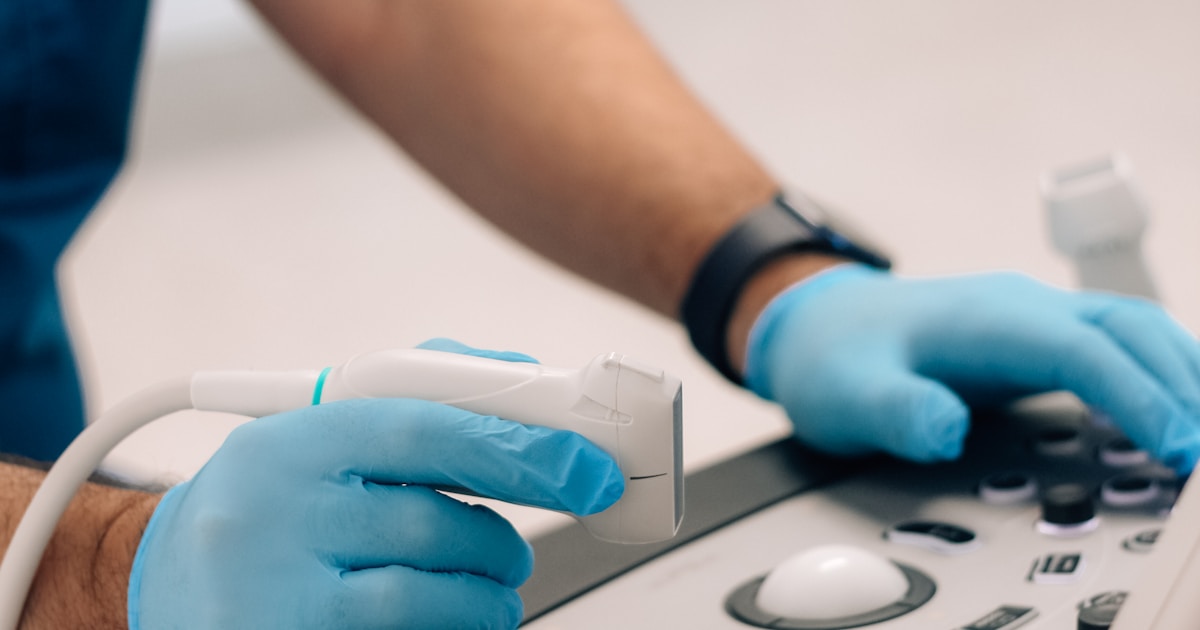
Butterfly Network (NYSE: BFLY) closed Thursday, June 18, 2026 at $8.90, up about 56% on more than 59 million shares — making the small-cap ultrasound-on-chip maker the NYSE’s top percentage gainer for a second straight day. The catalyst: Midjourney, the generative-AI company best known for image synthesis, used its first major launch event to unveil Midjourney Medical and a full-body imaging system — the Midjourney Scanner — built around 40 of Butterfly’s ultrasound-on-chip modules.
The Thursday surge took BFLY from the mid-$5s into the high $8s in two sessions and pulled the stock back above its November 2025 highs, when the underlying license agreement was first disclosed via 8-K.
What Midjourney Actually Bought
Butterfly’s deal terms have been public for months, even if the market only repriced them this week. The company filed an 8-K on November 17, 2025 disclosing an exclusive, non-transferable license to its ultrasound-on-chip technology, software, and backend stack within a defined field of use. Total expected payments: up to $74 million over a five-year term.
| Payment component | Amount | Schedule |
|---|---|---|
| One-time non-recurring fee | $15.0M | Upfront |
| Annual license fee | $10.0M / yr | Quarterly, 5-year term |
| Milestone payments | up to $9.0M | Specified milestones |
| Chip purchases & revenue share | Variable | As Midjourney ships hardware |
| Total fixed + milestones | up to $74.0M | Over 5 years |
The $50 million of contracted license fees plus the $15 million upfront put roughly $65 million on the floor over five years — already two-thirds of Butterfly’s trailing-twelve-month revenue of about $97.6 million, but locked in. The milestone payments, chip sales, and revenue share are upside that depends on whether Midjourney can actually move the scanner.
The Scanner That Caused The Pop
At its San Francisco launch event, Midjourney positioned the new product as a “large-scale computational tomography platform” — a full-body 3D imaging device that uses ultrasound rather than CT or MRI. Per Butterfly’s June 18 commentary, the prototype packs 40 ultrasound-on-chip modules, “about half a million sensors scanning simultaneously,” and two-plus petaflops of compute. The pitch: a one-minute, radiation-free full-body scan that does not require a magnet.
The first scanner is slated to deploy at a Midjourney-branded wellness spa in San Francisco. The company has signaled four hardware products in the pipeline — two handhelds and two larger systems — meaning the 40-module count could scale up materially in later generations.
Why The Market Repriced This Week
The agreement has been on file since November 2025, yet BFLY traded between $4 and $5 for most of the spring. Three things changed on June 17–18:
- Brand reveal. Until the launch event, “Midjourney customer” was a name in a footnote. Now there is a product photo, a price-point hint, and a celebrity launch venue — turning a licensing footnote into a marketable headline.
- Platform read-through. TD Cowen’s Joshua Jennings flagged the deal as proof that “BFLY Embedded” — the company’s licensing arm — is a real licensable infrastructure layer, not a one-off OEM contract. That reframes Butterfly from a money-losing hardware maker into a chip-licensor with optionality.
- Float math. Butterfly is a sub-$2B name with elevated short interest. A 59-million-share day on a single catalyst — versus a 20-day average that has historically run in the low single-digit millions — produces the kind of squeezy tape that adds 20–30 points of extra return on top of the fundamental repricing.
BFLY vs The Tape on Thursday
Even with the Russell 2000 putting up a strong day on the Fed's less-hawkish Summary of Economic Projections, BFLY’s move was twenty-six times the small-cap benchmark. That is the difference between a market-driven beta day and a single-name catalyst.
The Composition of $74M
What This Doesn’t Solve
Butterfly’s underlying business still loses money. The company runs an EBIT margin near minus 72% and burned roughly $15 million in free cash last quarter. The Midjourney run-rate of $10 million a year in license fees is meaningful — it is high-margin, recurring revenue — but it doesn’t change the operating math overnight. With $137.95 million of cash and $17 million of debt, Butterfly has cushion, not breakeven.
The bull case is platform: if Midjourney’s scanner moves enough units to drag chip sales and revenue-share payments materially above the $74 million floor, BFLY Embedded becomes a real licensing business with high incremental margins. The bear case is concentration: one customer’s product launch is now a meaningful chunk of the equity story, and Midjourney has never sold a hardware product before.
What To Watch Next
- Wellness-spa unit economics. Midjourney has signaled a consumer-facing launch venue. Pricing per scan and customer flow at the San Francisco location are the first real-world demand signal.
- Q2 BFLY print. Butterfly should begin recognizing the $15 million upfront over the contract period and the first quarterly $2.5 million license payment. Watch for explicit disclosure of “Midjourney revenue” as a line item.
- Regulatory pathway. A full-body scanner sold in a wellness-spa setting may sidestep FDA clearance under wellness exemptions, but any clinical positioning would change that. Midjourney’s exact regulatory posture has not been disclosed.
- FDA 510(k) docket for Midjourney Medical. A filing search on FDA’s 510(k) database is the cleanest tell.
Sources
- Butterfly Network Form 8-K, filed Nov 17, 2025 — disclosed deal terms
- Butterfly Network investor-relations commentary, June 18, 2026 — scanner module count and specs
- Yahoo Finance: Butterfly Network shares jump as Midjourney unveils imaging platform — TD Cowen analyst commentary, stock action
- InvestorIdeas: BFLY makes NYSE top gainer list two days in a row — close price $8.90, volume 59M+
- TheStreet market wrap, June 18, 2026 — index closes for the comparison chart
Disclosure: It is for informational purposes only and is not investment advice.