
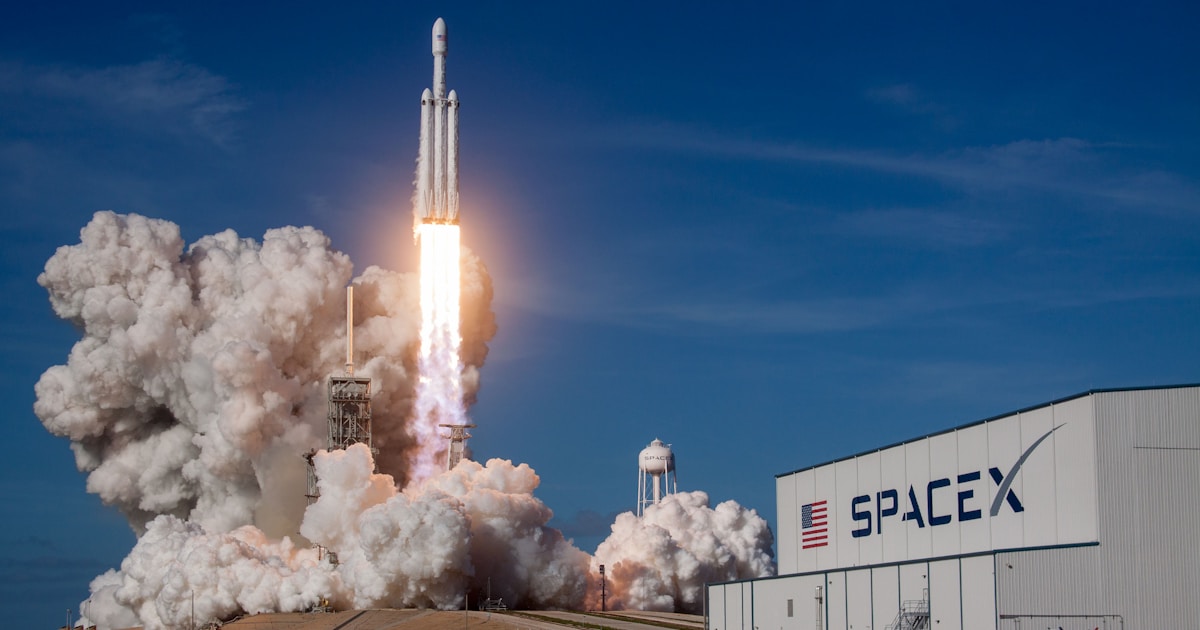
SpaceX filed its long-awaited S-1 registration statement with the U.S. Securities and Exchange Commission on May 20, 2026, kicking off what would be the largest initial public offering in capital-markets history. The filing — which lists the company under the proposed ticker SPCX on Nasdaq — targets pricing on June 11 and a first trading day of June 12, 2026, according to reporting on the prospectus.
Underwriters are marketing roughly $70 billion to $80 billion of stock at an implied equity value of $1.75 trillion to $2 trillion. At the midpoint, SPCX would raise more than two-and-a-half times Saudi Aramco’s $25.6 billion 2019 listing — currently the all-time record per official Tadawul pricing.
What the prospectus actually says
The S-1 covers fiscal year 2025 and the three months ended March 31, 2026. Top-line numbers, as reported from the filing:
- 2025 revenue: $18.7 billion, up ~33% from $14.1 billion in 2024.
- Q1 2026 net loss: $4.27 billion versus a $528 million loss in the prior-year quarter — a swing driven largely by accelerated Starship and AI capex.
- Accumulated deficit: $41.3 billion as of March 31, 2026.
- Starlink: contributed more than two-thirds of 2025 revenue and produced ~$1.2 billion of segment profit in the most recent quarter, according to filing data summarized by Fortune.
- R&D and capex: Starship absorbed roughly $3 billion in 2025 and another $930 million in Q1 2026; the AI division accounted for ~60% of total capital spending, or about $20 billion in 2025.
The S-1 also disclosed a 18,712 BTC corporate Bitcoin position carried at a cost basis of approximately $661 million and a fair value of about $1.29 billion at quarter-end, unchanged in size since 2024, per disclosures in the registration statement.
How SPCX stacks up against the biggest IPOs on record
| Issuer | Year | Gross Proceeds (USD) | Listing |
|---|---|---|---|
| SpaceX (SPCX) — proposed | 2026 (proposed) | $70–80B | Nasdaq |
| Saudi Aramco | 2019 | $25.6B ($29.4B w/ greenshoe) | Tadawul |
| Alibaba | 2014 | $21.8B (w/ greenshoe) | NYSE |
| SoftBank Group (Mobile) | 2018 | $21.3B | Tokyo |
| Agricultural Bank of China | 2010 | $22.1B (w/ greenshoe) | Shanghai / HK |
| ICBC | 2006 | $21.9B | Shanghai / HK |
Even at the bottom of the range, SPCX would be roughly 2.7x the size of Aramco — a jump big enough to redefine what the market means by “mega-IPO.”
Revenue trajectory at a glance
Control: Musk keeps the keys
The dual-class structure is the most aggressive seen in a U.S. mega-IPO. According to the filing, Elon Musk owns 93.6% of the Class B super-voting stock, giving him roughly 85% of total voting power pre-IPO. Post-offering, the prospectus indicates Musk’s voting power will stay above 50%, locking in founder control regardless of float size.
The charter also includes provisions allowing Musk to operate competing businesses while serving as CEO, CTO and chairman — and a one-billion-share performance grant that vests only if SpaceX establishes a permanent human colony of at least one million people on Mars. That kind of milestone-linked award is unusual for a public-company executive package and likely to attract proxy-advisor scrutiny.
The syndicate
SpaceX assembled one of the largest underwriting groups ever for a single offering — roughly 23 banks across U.S., European, Canadian, Australian and Asian distribution. Goldman Sachs is lead-left, with Morgan Stanley, Bank of America, Citigroup and JPMorgan Chase as joint active bookrunners. Regional anchors include Barclays (U.K.), Deutsche Bank and UBS (continental Europe), RBC (Canada), Mizuho (Japan) and Macquarie (Australia).
Risk factors worth flagging
- Persistent operating losses: The company has accumulated more than $41 billion in deficits and continues to spend heavily on Starship and AI, with no near-term path to GAAP profitability disclosed.
- Customer concentration: Government contracts (NASA, DoD) remain a meaningful share of launch revenue; congressional or agency budget shifts could move quarterly results.
- Key-person dependency: The S-1 explicitly identifies Musk as essential to the business, and the dual-class structure leaves limited investor recourse on governance.
- Mark-to-market volatility: The 18,712-BTC treasury swung from a $955 million unrealized gain in 2024 to a $112 million unrealized loss in 2025, introducing non-operating earnings volatility.
What to watch into June 12
Three things will shape pricing. First, the road-show response — at $1.75–$2 trillion, SpaceX would carry one of the richest revenue multiples ever applied to a hardware-heavy issuer. Second, AI-segment disclosures, where the prospectus revealed less granular numbers than investors had hoped for. Third, dual-listing dynamics: an additional Nasdaq Texas listing has been reported, which would route a slice of trading to the new venue and is a structural test case for that market.
For now, the headline is simple: the largest IPO in history has been formally filed, and the next three weeks of bookbuilding will decide whether the market is willing to underwrite a $2 trillion private space, satellite and AI conglomerate on its first day.
Sources
- SEC EDGAR — Space Exploration Technologies Corp Form S-1 filings
- TechCrunch — “The SpaceX IPO filing is filled with AI bets, Starship dreams, and Elon Musk at the center” (May 20, 2026)
- Fortune — SpaceX prospectus revenue / loss breakdown (May 20, 2026)
- Yahoo Finance / TradingKey — Goldman Sachs lead-left, syndicate composition
- Crypto Times — 18,712 BTC corporate treasury disclosure
- Al Jazeera — Saudi Aramco IPO pricing record reference
Disclosure: It is for informational purposes only and is not investment advice.