
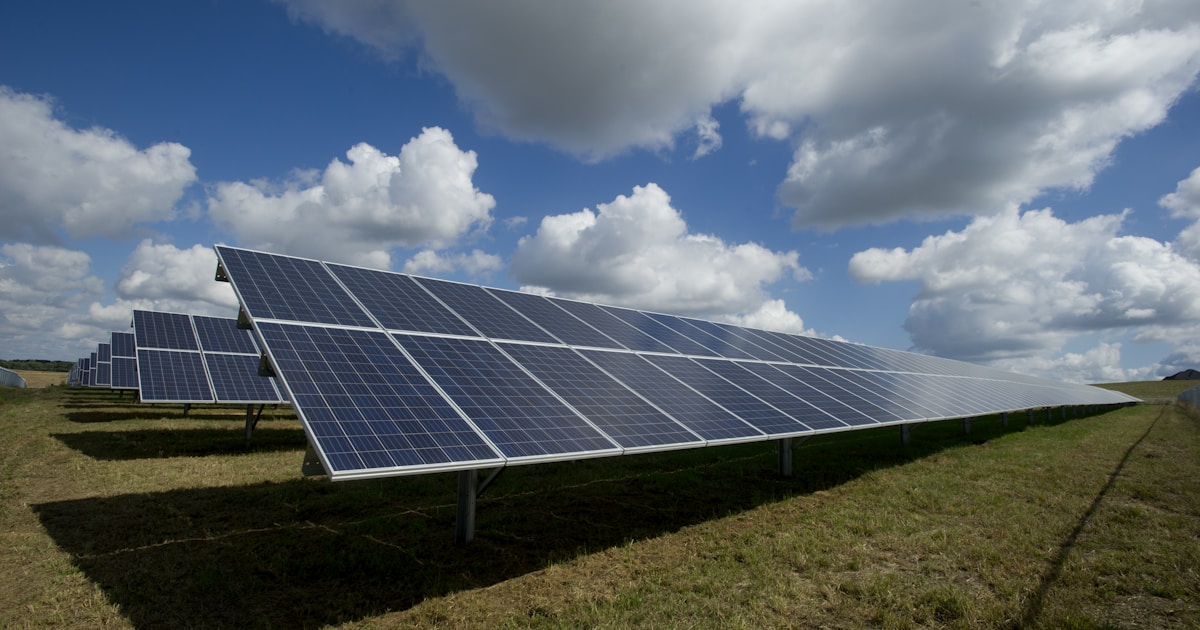
First Solar (NASDAQ: FSLR) ripped 10.86% higher to $303.38 on Thursday, May 28, 2026, the stock’s largest single-session gain of the year and its first close within $7 of an all-time high. The catalyst: a fresh wave of buy-side positioning ahead of an expected ruling in the Commerce Department’s Section 232 national-security investigation of imported polysilicon and its derivatives, the upstream feedstock for nearly every solar module sold in the United States.
The move added roughly $3.2 billion of market value in a single tape and pulled the rest of US-domiciled solar with it — Sunrun (RUN) closed up 4.54% at $15.89, while crystalline-silicon-heavy peers Enphase (ENPH) and SolarEdge (SEDG) traded flat to slightly lower as investors concentrated bets on the one US producer that does not rely on polysilicon at all.
Why Polysilicon Tariffs Are an FSLR Story, Not a Solar Story
Section 232 of the Trade Expansion Act of 1962 lets the President restrict imports the Commerce Department finds threaten national security. The Bureau of Industry and Security is actively running an investigation titled “Section 232 National Security Investigation of Imports of Polysilicon and Its Derivatives,” with comments tracked under Docket BIS-2025-0023 on Regulations.gov.
Polysilicon is the raw material almost every solar module starts with — except First Solar’s. The Tempe, Arizona-based company is the only at-scale Western producer of cadmium telluride (CdTe) thin-film panels, a non-silicon technology. That means any tariff that raises the landed cost of polysilicon, wafers, cells, or finished crystalline-silicon modules made overseas mechanically widens FSLR’s price umbrella against imports without raising its own costs.
Traders have been pricing this asymmetry for weeks. With the Commerce Department’s 270-day statutory clock approaching its end, Thursday’s tape read as the moment crowd positioning finally caught up to the calendar.
The Move in Context: Snapshot of US Solar on May 28, 2026
| Ticker | Company | Close | Day % | Market Cap | Tech Exposure |
|---|---|---|---|---|---|
| FSLR | First Solar | $303.38 | +10.86% | $32.6B | CdTe thin film (no poly) |
| RUN | Sunrun | $15.89 | +4.54% | $3.8B | Residential installer |
| SEDG | SolarEdge | $73.19 | -0.05% | $4.5B | Inverter / poly value chain |
| ENPH | Enphase Energy | $69.50 | -1.11% | $9.2B | Microinverters / batteries |
The dispersion is the story. When a tariff catalyst hits a sector, it usually lifts the whole boat. Here, the boat is splitting in two: a US-domiciled producer of the non-tariffed substrate (FSLR) against US importers and integrators whose unit economics get squeezed when poly costs rise (ENPH, SEDG). RUN sits in the middle — it buys panels but is a residential installer with pricing power on installed kW.
First Solar’s Underlying Business Was Already Working
The tariff trade is the spark, but the kindling is a balance sheet and order book that have quietly compounded for two years. According to company filings aggregated on stockanalysis.com:
- Revenue (TTM): $5.42 billion — a record at this stage of the build-out, with three new US factories ramping (Alabama, Louisiana, Ohio).
- Gross margin: 41.74%; net margin: 30.73% — both extraordinary for a hardware manufacturer.
- Trailing EPS: $15.48, putting the trailing P/E at about 19.6x and the forward P/E at 15.8x — a discount to the broader S&P 500 even after Thursday’s surge.
- Market cap: $32.6 billion, up 94.8% over the past 52 weeks against a 52-week range of $135.50 to $310.42.
The Section 232 catalyst is not free money — it is a step-function repricing of an FSLR thesis the market had been edging toward all year. The 52-week chart shows it: from a $135 low to a $303 close, with most of the gain coming as the Commerce Department’s investigation moved from comment period to draft determination.
What a Section 232 Polysilicon Tariff Could Actually Look Like
The Section 232 statute gives the President a menu of remedies once a national-security threat finding is made: tariffs, quotas, tariff-rate quotas, or negotiated agreements. Recent precedents — the 2018 steel and aluminum cases, and the 2025 critical-minerals action — landed in the 10%-to-50% tariff band, layered on top of existing duties and the Inflation Reduction Act-era Section 301 levies that already apply to Chinese-origin solar.
The Bureau of Industry and Security has confirmed two parallel Section 232 investigations relevant to solar: the polysilicon docket and a separate “Section 232 National Security Investigation of Imports of Processed Critical Minerals and Derivative Products”. Both remain open. Tellurium, the key input to FSLR’s CdTe technology, sits inside the critical-minerals docket — a reminder that the regulatory aperture cuts both ways.
Risks That Did Not Get Repriced Today
Three things would make Thursday’s move look like a peak rather than a re-rating:
- The Commerce determination disappoints. If the final remedy is a negotiated agreement rather than a hard tariff, or if tariff rates land at the low end of historical Section 232 outcomes, the asymmetry shrinks.
- Tellurium gets caught in the critical-minerals net. If the parallel investigation results in tariffs or export controls on tellurium-bearing inputs, FSLR’s own COGS rises.
- Demand falters. Solar deployment in the US runs on the interaction of tax credits, utility-scale procurement, and interconnection queues. A weaker demand backdrop would dilute any policy tailwind.
None of those risks materialized on Thursday. But the trade is now richly priced — FSLR closed within 2.3% of its 52-week high, with implied volatility in the front month elevated. Anyone modeling further upside from here is, in effect, modeling the tariff verdict itself.
The Read-Through for Solar Investors
For investors who use US solar as a proxy on energy policy, the May 28 tape clarified something. The Section 232 polysilicon investigation is not a uniform sector tailwind — it is a concentrated catalyst that favors one US-domiciled manufacturer with a non-silicon stack. The trade dispersion between FSLR and the silicon-dependent names is unlikely to fully close until the Commerce Department publishes its determination and the President signs (or declines to sign) the proclamation.
For the broader market, the move is a reminder that trade policy still moves single-name P/Es as forcefully as earnings — and that the policy calendar deserves a seat next to the earnings calendar on any investor’s watchlist.
Sources
- First Solar (FSLR) — stockanalysis.com price and overview
- First Solar (FSLR) — stockanalysis.com statistics page
- Enphase Energy (ENPH) — stockanalysis.com
- SolarEdge (SEDG) — stockanalysis.com
- Sunrun (RUN) — stockanalysis.com
- Bureau of Industry and Security — Section 232 investigations
- Docket BIS-2025-0023 — Section 232 polysilicon investigation comments
Disclosure: It is for informational purposes only and is not investment advice.