
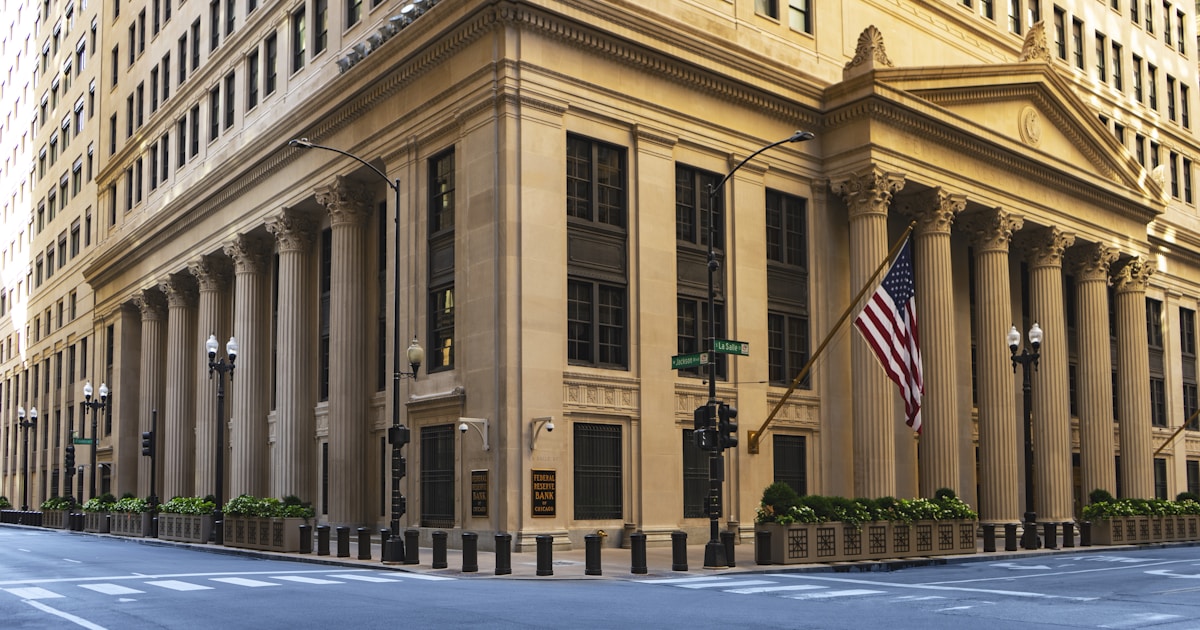
Kevin Warsh took the oath as chair of the Federal Reserve on May 22, 2026, inheriting an 8-4 Federal Open Market Committee, a federal-funds target of 3.50% to 3.75%, and a 30-year Treasury yield near 5%. His first meeting in the chair’s seat is June 16-17.
The Powell-to-Warsh handoff
President Donald J. Trump nominated Warsh on March 4, 2026. The Senate confirmed him as a Board member on May 12 and as chair on May 13. Between Jerome H. Powell’s exit and Warsh’s swearing-in, the Board named Powell chair pro tempore on May 15 — a continuity-of-leadership move “consistent with past practice during similar transitions between chairs.” Seven days later, Warsh took the oath and the FOMC unanimously elected him its chairman the same afternoon. His chairman term runs through May 21, 2030; his Board seat extends to January 31, 2040.
The rate complex he inherits
The bond market did not wait for Warsh. The Fed’s H.15 release for June 4, 2026 — the last reading before this piece — shows the curve sitting well above the Committee’s policy rate at the long end:
| Instrument | Yield (% p.a.) |
|---|---|
| Federal funds (effective) | 3.62 |
| 1-month T-bill | 3.62 |
| 3-month T-bill | 3.63 |
| 2-year Treasury | 4.05 |
| 5-year Treasury | 4.18 |
| 10-year Treasury | 4.47 |
| 30-year Treasury | 4.97 |
The 2-year sits roughly 30 basis points above the funds rate, and the 30-year is about 135 basis points above. That is a market that does not believe a cut is imminent and does believe term premium has reset higher.
A divided Committee
The composition of the FOMC matters more in transition periods than in steady states. The April 29 statement held the target range at 3.50% to 3.75% on a fractured 8-4 vote:
| Voter | Position |
|---|---|
| Stephen I. Miran | Dissented — wanted a 25 bp cut |
| Beth Hammack | Dissented — held, opposed easing bias |
| Neel Kashkari | Dissented — held, opposed easing bias |
| Lorie Logan | Dissented — held, opposed easing bias |
| Other 8 members | Held at 3.50%-3.75% with easing bias intact |
Miran has since resigned from the Board (May 14 announcement), but the broader picture stands: a Committee with three voters publicly resisting easing-bias language at the same time a fourth voter was lobbying for a cut. Warsh’s first job in June is to lead a body that does not yet agree with itself.
The dot plot vs the bond market
The most recent Summary of Economic Projections — from the March 17-18 meeting — pegged the median federal-funds rate at 3.4% for end-2026, 3.1% for end-2027, and a longer-run rate of 3.1%. Median real GDP growth was projected at 2.4% in 2026, slowing to 2.0% in the long run; the unemployment rate at 4.4%; and PCE inflation at 2.7% in 2026 fading to 2.0% by 2028. The end-2026 dot distribution is notably tight: seven participants projected 3.625%, seven projected 3.375%, with the remainder scattered between 2.625% and 3.750%.
The bond market is pricing something looser than the median dot at the front end but is unwilling to lean on cuts: the 2-year at 4.05% implies an average funds path well above the SEP median over the next two years. The April minutes flagged that participants “generally judged elevated inflation and Middle East uncertainty might necessitate maintaining current policy longer than anticipated” — language consistent with the long end’s stickiness near 5%.
What’s known about Warsh’s lean
Warsh is not a new face at the Fed. According to his Board biography, he served as a Fed governor from 2006 to 2011, sat on the President’s Working Group on Financial Markets during his earlier White House role (2002-2006), and previously spent seven years at Morgan Stanley (1995-2002). Between his two Board stints he was a visiting fellow at Stanford’s Hoover Institution and a partner at Duquesne Family Office.
The April minutes already indicate the Committee has stopped meaningful quantitative tightening: the directive authorized continued Treasury-bill purchases “to maintain an ample level of reserves” and rolled over principal payments rather than letting runoff continue. Whether Warsh accepts that operating posture is, in the near term, one of the more consequential balance-sheet questions for capital markets.
What to watch June 16-17
Three items are worth tracking when Warsh chairs his first FOMC meeting:
- The statement language — specifically whether the easing-bias phrasing the April dissenters opposed is softened or sharpened.
- The June SEP — the new dot plot will be Warsh’s first chance to influence the projected funds-rate path, and any drift higher in the longer-run dot would mark a hawkish reset.
- The balance-sheet directive — any change to the T-bill-buying language, or a renewed runoff schedule, would be the most market-moving line for fixed-income desks.
For now, the curve is doing the talking. A 30-year yield near 5% with the funds rate below 4% is a market saying: don’t cut yet, and rebuild term premium. Warsh inherits both of those signals on day one.
Sources
- Federal Reserve press release — Kevin Warsh takes oath of office (May 22, 2026)
- Federal Reserve press release — Powell named chair pro tempore (May 15, 2026)
- FOMC statement, April 29, 2026
- FOMC minutes, April 28-29, 2026
- FOMC Summary of Economic Projections, March 18, 2026
- Federal Reserve H.15 Selected Interest Rates (June 4, 2026 reading)
- Federal Reserve — Kevin M. Warsh biography
- FOMC calendar, 2026
Disclosure: It is for informational purposes only and is not investment advice.