
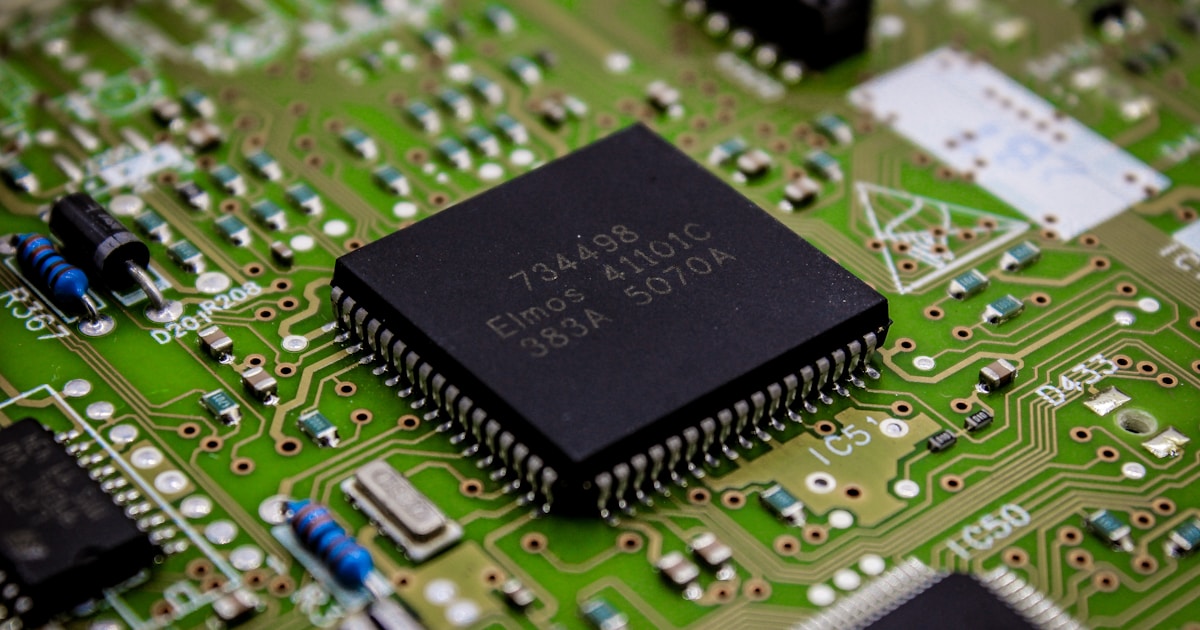
AXT Inc. (Nasdaq: AXTI) closed up 21.2% on May 1, 2026, after the semiconductor-substrate company reported Q1 2026 revenue of $26.9 million — a 39% jump from a year earlier — as exploding demand from AI data-center builders for indium phosphide (InP) wafers pushed the company toward a financial inflection point. The single-session surge added roughly $1 billion to the company’s market value and lifted shares to $96, blowing past the most bullish analyst price target on Wall Street.
Q1 2026 Results: Revenue Beat, Margin Expansion
The Fremont, California-based company’s first-quarter results marked one of its strongest revenue prints in recent history. Gross profit climbed to $8.0 million, pushing the gross margin to approximately 29.6% — a sharp improvement from the 21.0% recorded in Q4 2025 and the 22.2% in Q3 2025. Net loss narrowed significantly to $1.6 million, or $0.03 per diluted share, compared with a $3.6 million net loss the prior quarter.
The margin expansion is notable because substrate manufacturing is a capital-intensive, volume-sensitive business. When revenue rises and the product mix tilts toward higher-specification InP wafers — which command premium pricing — gross margins can move quickly. Q1 2026’s near-30% print signals exactly that kind of mix shift.
| Quarter | Revenue | Gross Profit | Gross Margin | Net Loss | EPS (Diluted) |
|---|---|---|---|---|---|
| Q3 2025 | $28.0M | $6.2M | 22.2% | ($1.9M) | ($0.04) |
| Q4 2025 | $23.0M | $4.8M | 21.0% | ($3.6M) | ($0.08) |
| Q1 2026 | $26.9M | $8.0M | 29.6% | ($1.6M) | ($0.03) |
| YoY Change (Q1) | +39.1% | ||||
What AXT Makes — and Why AI Needs It
AXT designs and manufactures compound semiconductor substrates — the crystalline wafer foundations on which chip manufacturers build their devices. The company’s flagship product is the indium phosphide (InP) substrate, a material with optical and electronic properties that set it apart from conventional silicon.
Silicon transistors switch electrons. InP devices interact directly with photons. That property makes InP-based chips the material of choice for high-speed optical transceivers — the modules that encode data as laser pulses and transmit them over fiber-optic cables. Inside every optical transceiver, an InP-based laser converts electrical signals to light, and an InP-based photodetector reverses the process at the receiving end. The substrate AXT ships is the starting material for those components. The company describes its InP products as designed for “data center connectivity using light/lasers, high-speed data transfer in data centers, 5G communications, and fiber optic lasers.”
AXT’s customers are transceiver and photonic component manufacturers that, in turn, supply the hyperscalers and cloud operators building AI infrastructure. The company sits at the very top of that optical supply chain — its output is a prerequisite for every high-speed optical link in a modern AI cluster.
The AI Optical Interconnect Buildout
Training large AI models requires moving enormous amounts of data between thousands of GPUs with minimal latency. Copper cables work for short distances at lower speeds, but as AI clusters scaled beyond hundreds of accelerators, optical interconnects became the only viable technology for sustained high bandwidth across the switching fabric. The industry has migrated from 100G to 400G and 800G transceivers, with 1.6T becoming a subject of active deployment planning at the largest cloud operators.
That progression matters directly to AXT. Each generation of faster transceivers demands InP wafers of greater diameter, purity, and surface quality. The move from 100G to 800G has substantially increased the amount of InP real estate needed per lane of optical bandwidth. More AI clusters, running faster optical links, translate directly into more wafer orders for AXT.
Meta, Microsoft, Alphabet, and Amazon have each disclosed multi-hundred-billion-dollar AI infrastructure investment programs extending at least through 2027. That pipeline gives transceiver manufacturers — and by extension their substrate suppliers — unusual revenue visibility compared with most semiconductor end markets.
Quarterly Revenue Trend
Analyst Reaction and Valuation Context
Wedbush Securities maintained its Outperform rating on AXT and raised its 12-month price target to $93 from $80 following the results, according to data from Yahoo Finance. The revised target, however, was already below the market’s reaction: at $96, AXT’s stock finished the session above even the most bullish target on Wall Street at that moment.
The company’s market capitalization reached approximately $6.1 billion at that closing price, according to StockAnalysis.com — implying a trailing price-to-sales multiple of roughly 64x on TTM revenue of $95.9 million. That is a rich valuation by traditional semiconductor hardware standards, and it reflects investors pricing in a steep forward acceleration in both revenue and margins.
Q1 2026’s 29.6% gross margin improves meaningfully on the 21.3% TTM average, and the narrowing net loss to just $1.6 million suggests the company’s operating leverage is beginning to show. Still, AXT has not yet posted a profitable quarter on a GAAP basis, and full-year profitability remains a forward expectation rather than a trailing reality.
Risk Factors to Watch
The AI optical buildout is a genuine and sustained demand driver, but AXT’s concentration of exposure to this single end-market creates vulnerability on both sides. Any moderation in hyperscaler AI capital expenditure — whether driven by cost discipline, technology shifts, or macroeconomic pressure — would ripple quickly to InP substrate demand.
Competition is another consideration. AXT operates in a niche but not a monopoly: other InP substrate suppliers, particularly manufacturers in Japan and other parts of Asia, participate in the market. Customers may qualify multiple sources, which would cap the pricing power that margin expansion requires.
Finally, the valuation gap between current fundamentals and implied expectations is wide. With the stock above even the most bullish analyst target and trading at 64x trailing sales, even a modest revenue miss or a guidance reduction could trigger a sharp re-rating.
What Comes Next
With formal Q2 2026 guidance still forthcoming from management, the immediate focus for investors will be whether AXT indicates that Q1 2026’s demand environment has continued into the current quarter. Order backlogs, customer concentration disclosures, and commentary on the pace of transceiver maker production ramps will all be closely parsed. At $96, the stock is pricing in a lot — and the next set of data points will determine whether that confidence is warranted.
Disclosure: It is for informational purposes only and is not investment advice.
Sources
- StockAnalysis.com — AXT Inc. Quarterly Financials
- StockAnalysis.com — AXT Inc. Overview (market cap, TTM revenue, business description)
- Yahoo Finance — AXT Inc. (AXTI) Analyst Ratings and Price Targets