
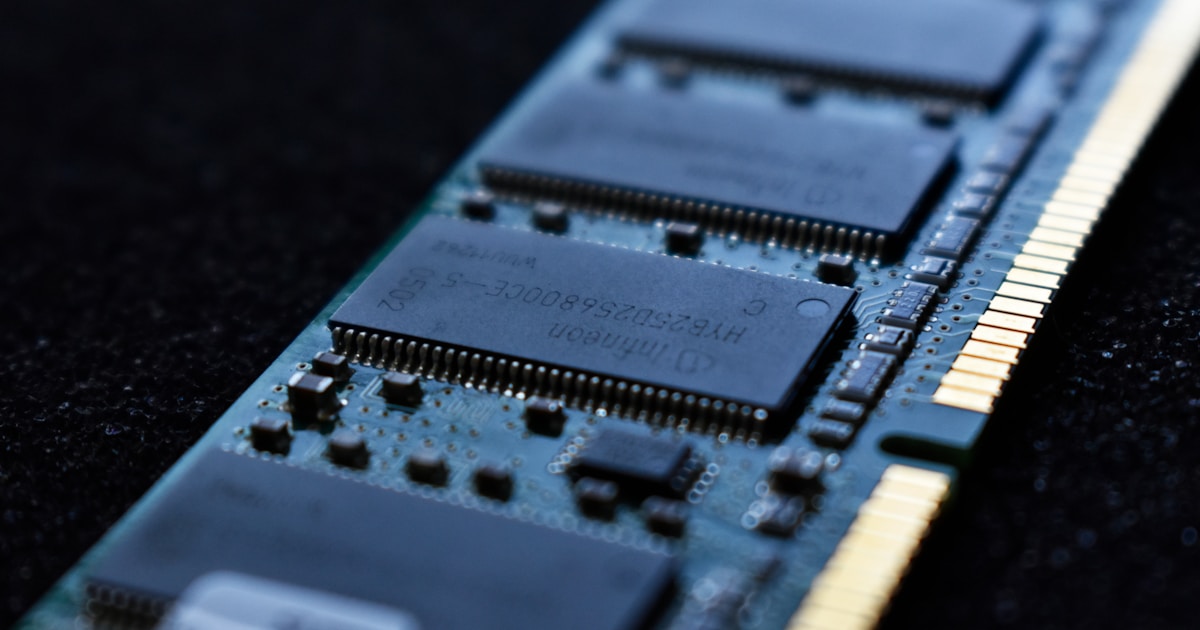
Two tickers told the same story on Wednesday from opposite ends. Apple (NASDAQ: AAPL) dropped 5.24% to $277.80 after raising prices on Macs and iPads, citing soaring memory chip costs. Micron Technology (NASDAQ: MU) surged 14.07% to $1,195.35 on a Q3 FY2026 print that briefly lifted its market cap past Meta and Tesla. The same force — AI-driven DRAM and HBM tightness — is now passing through to consumer electronics price tags.
The day’s tape
| Ticker | Company | Price | Day change |
|---|---|---|---|
| MU | Micron Technology | $1,195.35 | +14.07% |
| SNDK | SanDisk | — | +15.96% |
| AMAT | Applied Materials | — | +7.10% |
| SPY (S&P 500) | Broad market | 7,369.44 | +0.15% |
| AAPL | Apple | $277.80 | −5.24% |
What Apple actually did
Apple lifted MSRPs across the Mac and iPad lineups on Wednesday and acknowledged that the increase reflects sharply higher input costs for memory chips. The move covers MacBook configurations and iPad models, and applies to home device SKUs as well, according to coverage aggregated by Investing.com. Analysts were quick to react: Evercore ISI kept its Outperform rating with a $365 target but explicitly flagged “memory cost pressures,” while UBS stayed Neutral at $296, layering on a separate concern around China iPhone demand.
Two things make the price action sting more than the headline percentage. First, Apple has historically absorbed component-cost volatility rather than passing it through — gross margin discipline is part of the equity story. A visible MSRP increase signals that the cost shock is large enough to dent that playbook. Second, the price move comes into a tape where the broader market was up, the chip sector was up sharply, and Apple alone took the hit. That isolation is what shaved roughly $230 billion off Apple’s market value in a single session at the day’s intraday lows.
Why Micron is on the other side
Micron’s Q3 FY2026 results released Wednesday delivered adjusted EPS of $25.11 on revenue of $41.46 billion, well above consensus. Management’s commentary, summarized in Yahoo Finance’s news feed, pointed to a roughly $50 billion forward revenue trajectory tied to AI data-center memory demand, particularly High Bandwidth Memory (HBM) used alongside GPUs.
The sell side responded in kind. DA Davidson reiterated Buy and raised its price target to $2,000 from $1,500, while Argus initiated coverage describing “exceptional growth.” The combination of an earnings beat, a 50%+ forward revenue lift, and a fresh analyst upgrade cycle is the textbook setup that pushes a stock through prior highs — and that is what happened. Micron briefly traded above the market caps of both Meta Platforms and Tesla during the session before settling slightly lower into the close.
The memory squeeze, explained
Memory has always cycled. Periods of glut — cheap RAM, falling smartphone bills of materials — alternate with periods of scarcity. What is different this cycle is the demand driver. Generative AI workloads consume memory in two large bites: training-time HBM bolted to GPUs, and inference-time DRAM in data-center servers. Both are sourced from a tight oligopoly (Micron, Samsung, SK Hynix) and both have multi-year capacity lead times. The result is that consumer DRAM — the kind that goes into Macs, iPads, and PCs — competes for the same wafers and the same packaging capacity as AI memory. The pricing follows.
For Apple, the leverage point is the bill of materials on a configured Mac or iPad. Memory is one of the few line items that scales aggressively by SKU — an 8 GB to 16 GB or 16 GB to 32 GB upgrade carries one of the highest gross-margin tags in the lineup. When the underlying contract DRAM price moves up, Apple either compresses the margin on those upgrade tiers or raises the consumer MSRP. Wednesday’s announcement is the second option.
What it means for the rest of the stack
Micron is not the only beneficiary. SanDisk closed up nearly 16%, reflecting strength in NAND alongside DRAM, and equipment maker Applied Materials added 7.1% on the read-through to fab capex. PC makers (HP, Dell), other consumer-electronics OEMs, and even cloud hyperscalers will face the same input cost — the question for each is how much of the increase they can pass through. Apple chose to pass; commodity PC builders typically cannot.
On the demand side, the open question is whether higher MSRPs dent unit volumes. Apple’s installed base and ecosystem lock-in give it more pricing power than peers, but holiday-quarter demand elasticity matters. If Mac and iPad unit growth slows materially in Q1 FY27, the price hike will trade margin gain for revenue mix — not a clean win.
What to watch
- Micron’s HBM mix and pricing. The Q3 transcript will quantify what share of revenue is now HBM and how contract prices are trending into FY27.
- Samsung and SK Hynix. If the duopoly partners signal similar capacity-constrained pricing, the cycle has further to run; if either flags volume normalization, the squeeze is closer to peak.
- Apple’s gross margin guide. The next earnings call will translate the price hike into a margin number — the cleanest read on whether the increase fully offsets memory inflation.
- PC OEM commentary. Dell and HP earnings will indicate how much memory cost is being passed through outside Apple’s premium price umbrella.
Bottom line
Wednesday’s split tape is what a real, demand-driven memory cycle looks like once it reaches the consumer. Micron’s record-quarter print and Apple’s price hike are not two stories — they are the same story, just measured at different points in the supply chain. The market priced both ends accordingly: scarcity premium to the producer, margin discount to the buyer. Whether the cycle peaks in two quarters or twelve will determine which side of the trade is more durable.
Sources
- Yahoo Finance — Micron (MU) quote, Q3 FY26 earnings highlights, analyst PT updates (accessed June 25, 2026)
- Yahoo Finance — Apple (AAPL) quote and price-hike commentary (accessed June 25, 2026)
- Investing.com — Micron news roundup and sector winners list (June 25, 2026)
- Investing.com — Apple price hike on Macs and iPads (June 25, 2026)
- Micron Investor Relations — Quarterly Results (primary filings)
Disclosure: It is for informational purposes only and is not investment advice.