
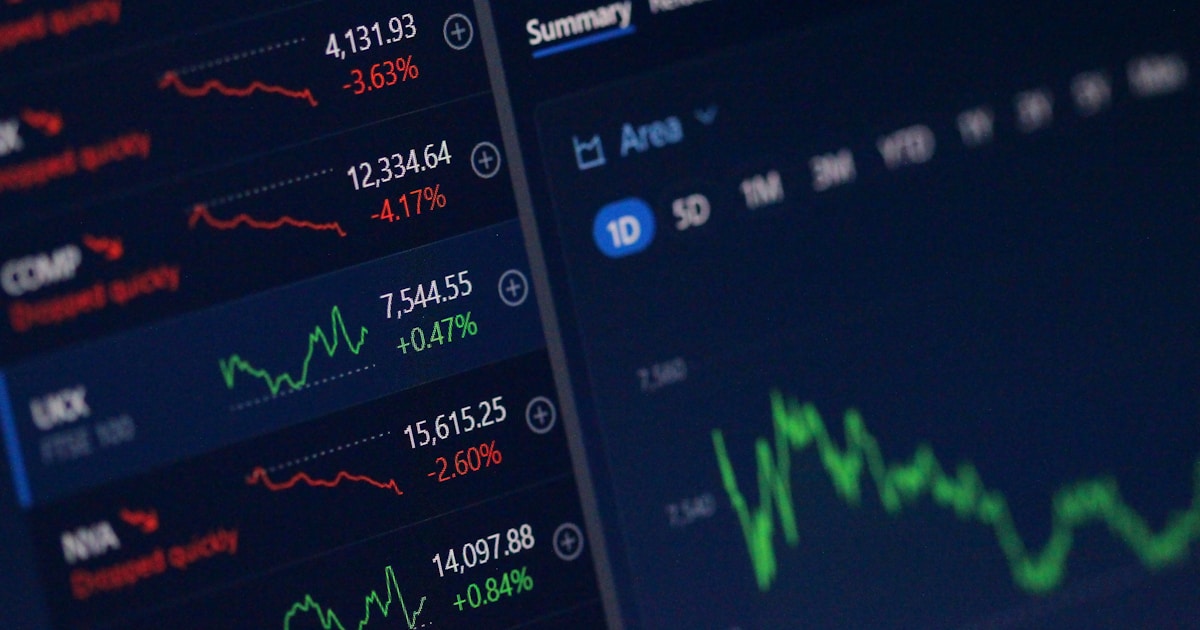
The hottest inflation reading in two years landed this morning, and the AI trade absorbed the punch.
The Bureau of Labor Statistics’ April Consumer Price Index came in at 3.8% year-over-year, the highest print since
May 2023 (BLS CPI). U.S. equities sold off in unison, with semiconductors and
mega-cap tech leading the slide. The Nasdaq Composite fell 1.54% to 26,225, the S&P 500 dropped 1.24% to
7,408, and the small-cap Russell 2000 — the most rate-sensitive of the bunch — gave back 2.44%.
The tape, at a glance
| Index / Asset | Level | Change | % Change |
|---|---|---|---|
| S&P 500 | 7,408.50 | -92.74 | -1.24% |
| Nasdaq Composite | 26,225.15 | -410.08 | -1.54% |
| Dow Jones Industrial | 49,526.17 | -537.29 | -1.07% |
| Russell 2000 | — | — | -2.44% |
| WTI Crude | — | — | +4.23% |
Why a CPI print this hot stings the AI trade hardest
Two mechanics did the damage. The first is duration. Long-duration growth equities — the AI capex story, hyperscaler
infrastructure plays, software platforms with cash flows weighted years out — have valuations that are exquisitely sensitive
to the discount rate. A hotter-than-expected CPI pushes the market-implied path of Fed cuts further out, which lifts the
discount rate, which compresses the present value of those future cash flows. That math hits semiconductors and
mega-cap tech before it hits a utility or a tobacco stock.
The second mechanic is sentiment. Wall Street has spent the better part of two quarters debating whether AI multiples
already imply flawless execution. With today’s CPI surprise, that debate snapped into action. Jefferies’ equity strategists
pushed back, arguing that the rally is supported by actual earnings expansion rather than multiple inflation, but the
counter-view — that AI valuations are starting to resemble
late-1990s extremes — drew louder coverage on the desk.
The biggest single-name moves
Inside the semis, Nvidia (NVDA) fell 4.4% to $225.32, Intel (INTC) dropped 6.2% to
$108.77, and Micron (MU) — the high-bandwidth memory bellwether — slid 6.6% to $724.66. Even
Tesla (TSLA), which trades on its own catalysts more often than not, was caught in the downdraft, off
4.75% to $422.24. Ford (F) led the broader complex lower at -7.46%, which itself bleeds into the read on
consumer credit and auto-loan delinquencies if rates stay elevated.
The standouts on the green side were narrow and narrative-specific. Microsoft (MSFT) rose 3.05% as
investors rotated within tech toward names with diversified cash flows and a real software annuity. Figma (FIG)
popped 13.2% on the back of its Q1 print, which ECMSource covered in
our earnings note here.
Oil’s countertrend rally adds a second inflation channel
WTI crude jumped 4.23% on the day, with Brent up 3.35%. The catalyst is the same one that has been on the desk all
week: shipping tension around the Strait of Hormuz. Roughly a fifth of global oil consumption transits the strait
(U.S. EIA: World Oil Transit Chokepoints), so even
the perception of disruption translates directly into the front-month crude curve. From a market-mechanics standpoint, an
oil rally on a hot CPI day is doubly hostile to growth equities: it tightens financial conditions and adds a forward
inflation impulse via gasoline and freight.
What the print does to the Fed path
The Federal Reserve’s longer-run inflation target is 2%, “measured by the annual change in the price index for
personal consumption expenditures” (Fed FAQ on the
2% target). CPI is not PCE — the headline CPI tends to run hotter than core PCE because of its larger shelter weight
and different methodology — but at 3.8% YoY the gap to target is large enough that the rates desk is unlikely to dismiss
it as transitory.
That translates into a familiar reflex. Two-year Treasury yields, which trade off the front-end Fed path, are the
fulcrum: when CPI surprises to the upside, the 2-year leads the long end higher, the curve flattens, and the discount
rate on long-duration cash flows rises. Markets that priced in two-to-three additional cuts before today’s print will
need to mark that path lower, and that is the conversation that will dominate desks into the next FOMC.
What we are watching from here
- The CPI internals. Headline at 3.8% is the headline. The reaction function is in core (ex-food and energy), supercore (services ex-housing), and shelter — those determine whether this is a noisy one-month read or the start of a re-acceleration.
- The 2-year Treasury yield. The cleanest read on the market-implied Fed path. A move toward or through prior cycle highs would compound the equity drawdown.
- AI capex commentary. Hyperscalers report on staggered schedules; any softening of capex guidance from a name like Microsoft, Meta, or Alphabet would amplify the semis pain.
- Crude. If WTI holds its 4% gain into the weekly inventory print, the secondary inflation channel through gasoline becomes a story for next month’s CPI as well.
Sources
- Bureau of Labor Statistics — Consumer Price Index program page
- Federal Reserve — FAQ: Why does the Federal Reserve aim for inflation of 2 percent in the longer run?
- U.S. Energy Information Administration — World Oil Transit Chokepoints — Strait of Hormuz
- Yahoo Finance — Markets dashboard and Most-Active Stocks, intraday May 16, 2026
- Yahoo Finance news roll — Stock market news headlines, May 16, 2026
Disclosure: It is for informational purposes only and is not investment advice.