
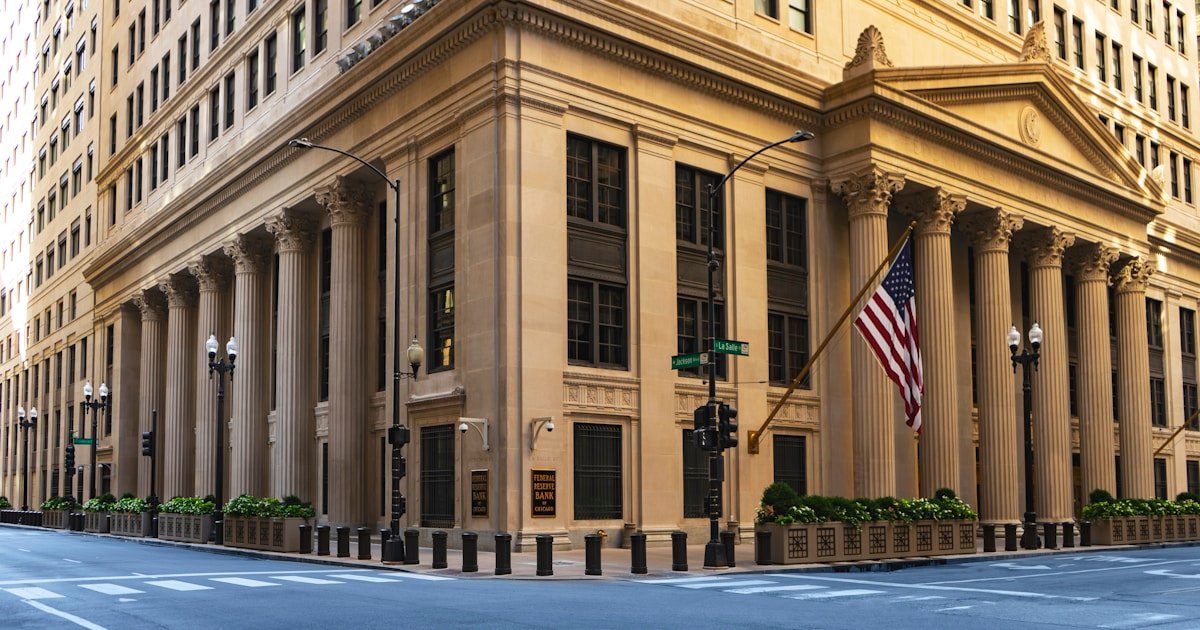
The Federal Reserve on Tuesday released the minutes of its July discount rate meetings, and the takeaway for bond investors is a clean one: the hawkish contingent inside the Federal Reserve System doubled in nine days. Four Reserve Bank boards — Cleveland, Minneapolis, Kansas City, and Dallas — had voted to raise the primary credit rate to 4.00% by the time the Board sat down on July 29. On July 20, only two had.
The Board of Governors overrode the hawks both times and held the primary credit rate at 3.75%, matching the top of the FOMC’s 3.50%–3.75% target range for the federal funds rate. But the discount rate ledger is one of the earliest windows into where regional Fed presidents want policy to go, and it now shows a hawkish coalition big enough to matter into September.
What the July minutes actually said
The discount rate — formally the primary credit rate — is the rate the Fed charges healthy banks that borrow overnight at the discount window. Under a policy in place since March 2020, it’s set at the top of the FOMC’s target range for fed funds. Each Reserve Bank’s board of directors votes on the rate; the Board of Governors reviews and determines the final number.
At the July 20 meeting, ten of the twelve Reserve Bank boards had voted to keep the primary credit rate at 3.75%. Two — Cleveland and Minneapolis — voted on July 16 to raise it to 4.00%. The Board took no action on those requests.
By the July 29 joint meeting with the FOMC, the board of the Kansas City Fed and the board of the Dallas Fed had joined the hawks, both voting on July 23 to move to 4.00%. Cleveland and Minneapolis carried their July 16 hike votes into the July 29 meeting. Three boards — New York, Richmond, and Atlanta — voted July 23 to stay at 3.75%. The remaining five boards’ July 16 hold votes rolled forward.
| Reserve Bank | July 20 vote | July 29 vote | Shift |
|---|---|---|---|
| Cleveland | Hike to 4.00% | Hike to 4.00% | — |
| Minneapolis | Hike to 4.00% | Hike to 4.00% | — |
| Kansas City | Hold at 3.75% | Hike to 4.00% | Flipped hawk |
| Dallas | Hold at 3.75% | Hike to 4.00% | Flipped hawk |
| New York | Hold at 3.75% | Hold at 3.75% | — |
| Richmond | Hold at 3.75% | Hold at 3.75% | — |
| Atlanta | Hold at 3.75% | Hold at 3.75% | — |
| Boston | Hold at 3.75% | Hold (rolled over) | — |
| Philadelphia | Hold at 3.75% | Hold (rolled over) | — |
| Chicago | Hold at 3.75% | Hold (rolled over) | — |
| St. Louis | Hold at 3.75% | Hold (rolled over) | — |
| San Francisco | Hold at 3.75% | Hold (rolled over) | — |
| Tally | 2 hike, 10 hold | 4 hike, 8 hold | Hawks 2 → 4 |
The hawks lined up with the FOMC dissent
The discount rate vote isn’t a policy decision by itself, but it maps almost one-to-one onto the FOMC dissent. When the FOMC delivered its rate decision on July 29, three district presidents voted against holding fed funds steady and in favor of a 25-basis-point hike: Cleveland’s Beth Hammack, Minneapolis’ Neel Kashkari, and Dallas’ Lorie Logan. All three of their district boards had also voted to raise the discount rate. The final FOMC vote was 9–3.
The Kansas City board joined the discount rate hawks even though its president isn’t a 2026 voting member — a signal that the hawkish coalition extends beyond the FOMC roster. It suggests the September meeting will not be a quiet one.
What the hawks are seeing
The minutes are unusually candid about the anecdotal read the Reserve Bank directors reported to the Board. Several directors “commented on elevated inflation and noted that consumers were becoming increasingly price conscious,” and most cited “rising fuel prices and surcharges stemming from global events.” Employment was described as steady, and directors flagged continuing AI capex as a productivity tailwind — but the through-line was that inflation is not yet cooperating.
That framing lines up with the market’s read of the July 29 FOMC statement, which held the fed funds range at 3.50%–3.75% and left the interest rate on reserve balances at 3.65%. With headline inflation still uncomfortably above target and Treasury yields already grinding higher into August — the 30-year traded above 5% earlier this month — a bloc of Fed officials that wants tighter policy is not a small thing for bond markets.
Why this matters for capital markets
Three practical implications for anyone underwriting or trading duration and credit:
- The September FOMC path is not settled. With three regional presidents already on record dissenting for a hike and a fourth board (Kansas City) siding with them on the discount rate, the September statement risks either another 3-vote dissent or, less likely, a policy pivot toward tightening if the data cooperates.
- Front-end pricing has room to reprice. The 2-year Treasury and SOFR futures are the cleanest expressions of the near-term FOMC path. A rising hawkish coalition adds a “policy tail” that isn’t currently priced.
- Curve and credit spreads track the message, not just the print. Hawks in ascendance historically flatten the front of the curve and steepen the belly-to-long — and can widen IG spreads at the margin if markets read it as later-cycle risk.
What to watch next
The next FOMC meeting is scheduled for September 15–16, 2026, and will include an updated Summary of Economic Projections (the “dot plot”). Between now and then, watch three markers: the August CPI release, the August employment report, and any regional Fed president speech that clarifies the four hawks’ bar for switching from dissent to majority. If any two of those markers surprise hawkish, the discount rate ledger tells you which four board rooms will move first.
Sources
- Federal Reserve — Minutes of the Board’s discount rate meetings on July 20 and July 29, 2026 (released Aug 25, 2026)
- Discount rate meeting minutes (PDF)
- FOMC statement, July 29, 2026
- Federal Reserve — About the discount rate
- FOMC meetings calendar
Disclosure: This article is for informational purposes only and is not investment advice.