
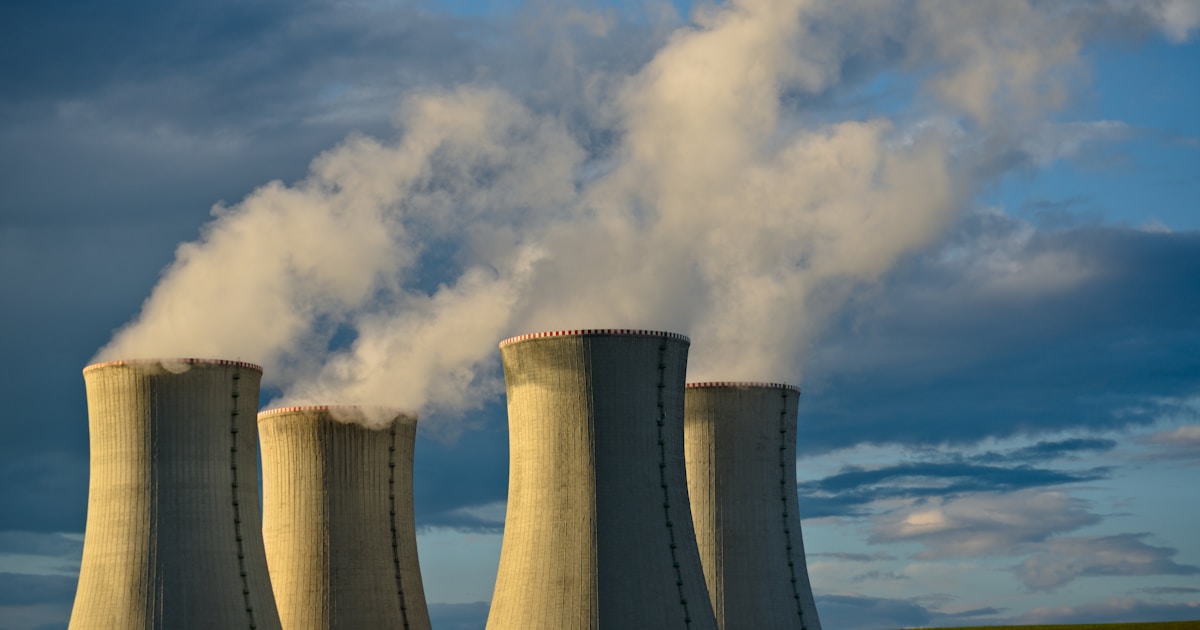
Amazon-backed nuclear startup X-Energy made its Wall Street debut on Thursday, raising $1.02 billion in one of the year’s most closely watched clean-energy initial public offerings. The stock surged nearly 27 percent, signaling that institutional investors are willing to pay a steep premium for pre-commercial nuclear technology — provided the right names are on the cap table.
X-Energy listed on the NASDAQ under the ticker XE at $23 per share, having upsized the offering well above the original $16–$19 guidance range. Shares opened at $30.11 and settled at $29.20, giving the Rockville, Maryland-based company a market capitalization of roughly $11.6 billion at the close — for a business that has yet to sell a single commercial unit of electricity.
What X-Energy Actually Does
Founded in 2009, X-Energy is developing a small modular reactor (SMR) called the Xe-100, a high-temperature gas-cooled reactor (HTGR) using pebble-bed architecture. Unlike the large light-water reactors that have powered the grid for decades, the Xe-100 is modular, factory-assembled, and sized for deployment at industrial sites and data center campuses.
Each Xe-100 unit produces 80 megawatts of electricity (200 megawatts of thermal energy). Four units co-located in a “four-pack” configuration deliver 320 MWe — enough to power a large data center cluster or a mid-sized industrial complex. The reactor can also supply high-temperature steam at up to 565°C for industrial process heat applications.
The fuel is equally distinctive. X-Energy manufactures TRISO-X, a proprietary variant of TRISO (Tri-structural Isotropic) particle fuel. Each particle encases a uranium kernel in multiple ceramic layers, embedded in a graphite sphere. The U.S. Department of Energy has described TRISO fuel as “the most robust nuclear fuel on earth.” Unlike conventional uranium fuel rods, TRISO particles retain structural integrity even in extreme accident scenarios, without relying on water cooling to prevent a meltdown.
Key safety characteristics of the Xe-100 include a negative temperature coefficient — the physics of the reactor naturally slows fission as temperatures rise, providing an inherent shutdown mechanism — along with a road-transportable, modular design and a projected 60-year operational life.
The Amazon Endorsement That Changed Everything
X-Energy’s IPO trajectory changed materially in 2024, when Amazon committed $500 million in a Series C-1 funding round. The investment was not purely philanthropic: Amazon Web Services is building out data center capacity at a pace that strains the existing power grid, and nuclear offers something wind and solar cannot — firm, dispatchable, carbon-free baseload power that runs 24 hours a day regardless of weather conditions.
The strategic logic is straightforward: a hyperscaler that needs 500 megawatts of reliable, low-carbon electricity cannot wait for the grid to catch up. By backing a reactor developer early, Amazon secures both the technology and a preferential position in the deployment queue. Ken Griffin, founder of Citadel, also holds an investment stake in X-Energy.
| IPO Detail | Value |
|---|---|
| Ticker / Exchange | XE / NASDAQ |
| IPO Date | April 24, 2026 |
| Initial Price Range | $16.00 – $19.00 |
| Final IPO Price | $23.00 |
| Shares Offered | ~44.3 million |
| Gross Proceeds | $1.02 billion |
| Debut Open | $30.11 (+30.9% vs. IPO price) |
| Debut Close | $29.20 (+26.96%) |
| Market Cap (Apr. 25) | $11.58 billion |
| Key Strategic Backer | Amazon ($500M, 2024) |
How the Book Was Built: Upsizing as a Signal
The pricing process itself told a story. X-Energy’s underwriters initially marketed the deal at $16–$19 per share. By the time the order book closed, demand had outstripped supply to the point where the final price landed at $23 — 21 percent above the top of the initial range. Upsizing a deal this aggressively is a reliable indicator of institutional conviction: fund managers rarely pay a double-digit premium to a price range unless they believe the aftermarket will hold.
They were right. The stock opened 31 percent above the IPO price and gave back only a fraction of those gains by the close, finishing the day up 27 percent. That is a cleaner debut than many of 2026’s early offerings, in a year that has already seen 104 U.S. IPOs priced as of this writing.
The Financial Reality: Early-Stage, High Conviction
Investors buying at an $11.6 billion valuation are underwriting a company that has not yet deployed a commercial reactor. X-Energy’s fiscal year 2025 financials, as reported in its public filings, show $109.1 million in revenue — primarily from government development contracts and fuel research programs — alongside a net loss of $389.8 million and negative free cash flow of $267.1 million.
That cash burn is real. The IPO proceeds substantially extend the company’s runway and will fund completion of the TRISO-X fuel fabrication facility — which X-Energy is building to create the first commercial-scale TRISO fuel plant in the United States — as well as the Xe-100 demonstration project. But the path from demonstration reactor to large-scale commercial deployment involves regulatory licensing, utility offtake agreements, and project financing that could span years.
Nuclear Capital Markets: The Broader Context
X-Energy’s IPO is the latest chapter in what capital markets have been pricing as a nuclear renaissance. Microsoft signed a 20-year power purchase agreement to restart a Three Mile Island unit in Pennsylvania. Alphabet signed a deal with Kairos Power. Constellation Energy, the dominant nuclear operator in the United States, has seen its shares more than double over two years on the back of data center power demand.
The common thread is AI infrastructure. Training large language models and running inference at scale requires continuous, reliable electricity — and data center developers have discovered that the permitting constraints and intermittency of renewables create bottlenecks. Nuclear is the only carbon-free source that delivers firm power at large scale from a small physical footprint.
The Advanced Reactor Demonstration Program at the U.S. Department of Energy has provided X-Energy and other developers with cost-share funding, reducing early-stage capital requirements and validating the technology pathway for institutional investors who would otherwise struggle to underwrite pre-commercial nuclear risk.
What to Watch
The critical milestones for XE shareholders will be: NRC design certification progress for the Xe-100, the operating date for the TRISO-X Oak Ridge fuel fabrication facility, and the announcement of utility partnerships committing to site the first commercial four-pack. Any slippage in those timelines — historically the norm in nuclear project development — will test investor patience at an $11.6 billion entry valuation.
For now, the IPO market’s verdict was unambiguous: Amazon’s $500 million endorsement, a book built well above initial guidance, and a 27 percent first-day pop put X-Energy among the most consequential clean-energy capital markets events of 2026.
Sources
- Stock Analysis — X-Energy (XE) Company Overview
- Stock Analysis — X-Energy Financial Statements
- Stock Analysis — 2026 U.S. IPO Tracker
- X-Energy — Xe-100 Reactor Technology
- U.S. Department of Energy — Advanced Reactor Demonstration Program
Disclosure: It is for informational purposes only and is not investment advice.