
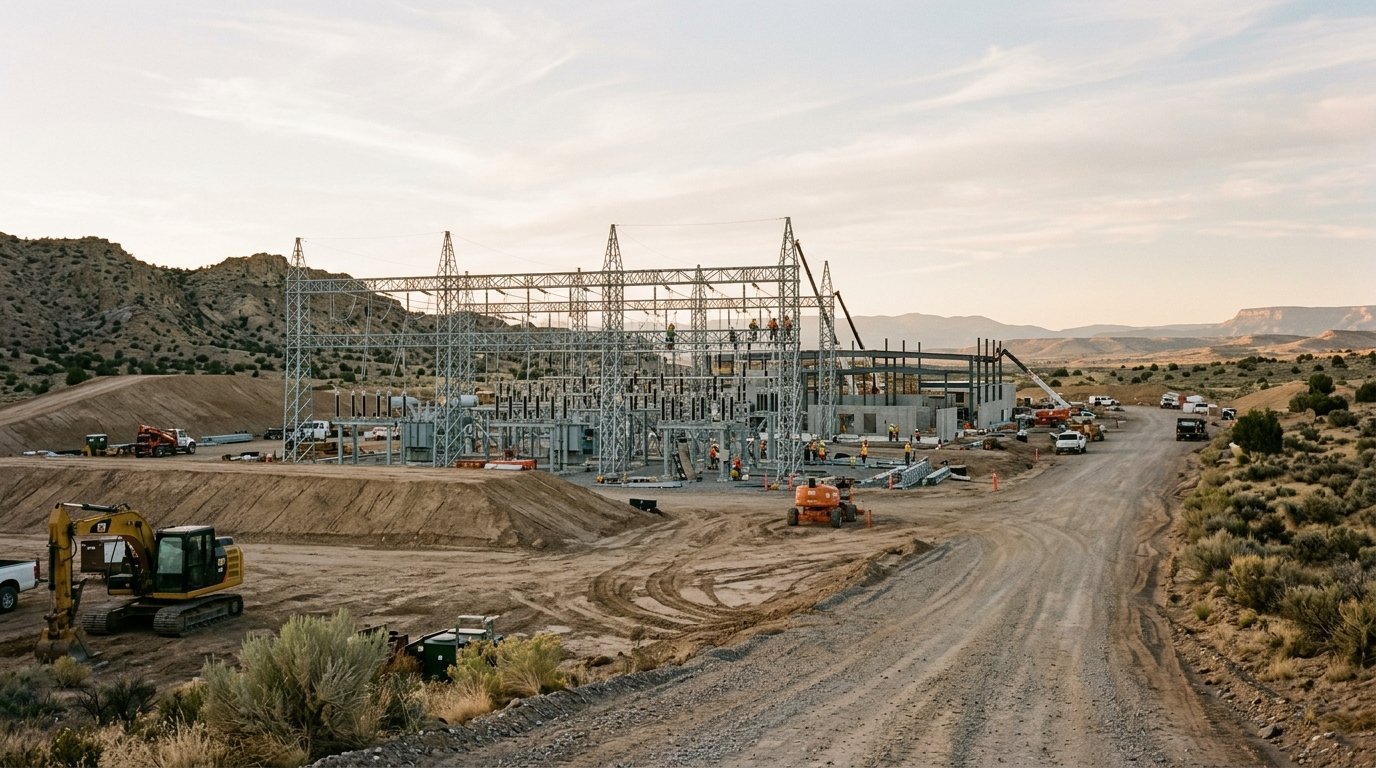
On September 24, 2026, Oracle Corporation issued a formal force majeure notice to developer Blue Owl Capital regarding Project Jupiter, the massive $165 billion, 2.45-gigawatt artificial intelligence data center campus under development in New Mexico. The legal maneuver seeks to preserve Oracle’s right to defer contractual lease payments if persistent natural gas pipeline permitting delays prevent the site from meeting its 2028 operational target. Oracle shares traded lower during the Thursday session as equity and credit investors assessed infrastructure delivery bottlenecks against the company’s rapidly expanding balance-sheet commitments.
Despite the formal notice, Oracle emphasized that it is not walking away from the project or abandoning its position as anchor tenant. An Oracle spokesperson stated that Project Jupiter remains on the company’s planned schedule and reiterated its ongoing commitment to the New Mexico development. However, the legal invocation highlights a growing friction point across mega-cap artificial intelligence infrastructure: contractual capital commitments colliding with the physical realities of grid interconnection, fuel pipelines, and regulatory clearances.
Key Takeaways
- Contractual Protection, Not Project Exit: Oracle’s force majeure notice to a unit of Blue Owl Capital establishes legal protection to pause or defer lease payments without incurring default penalties if delivery slips past 2028.
- Permitting Bottlenecks: Delays stem from repeated permit rejections by the New Mexico State Land Office for a critical 17.8-mile natural gas pipeline intended to supply on-site power generation.
- Capex Trajectory: In its recent Form 10-Q for the quarter ended August 31, 2026, Oracle reported that first-quarter capital expenditures surged to $28.5 billion, driven by aggressive cloud infrastructure build-outs.
- Stargate Initiative Exposure: Project Jupiter represents a central physical node in the broader Stargate AI computing alliance alongside OpenAI and SoftBank, designed to house up to 2.45 gigawatts of compute capacity.
The Permitting Dispute in the New Mexico Desert
Project Jupiter was conceived as one of the largest single-site data center campuses in the world, spanning thousands of acres in New Mexico and designed to support high-density supercomputing clusters. To solve the immense regional power shortfall, the campus design relied heavily on dedicated on-site power generation, integrating solid oxide fuel cells and natural gas turbines. As previously analyzed when Oracle partnered with Bloom Energy for 2.8 GW of fuel cell power, off-grid and behind-the-meter generation became essential to bypass multi-year utility queue delays.
However, securing fuel for on-site power proved equally complex. The project encountered substantial regulatory and environmental friction when the New Mexico State Land Office denied right-of-way permits for a proposed 17.8-mile natural gas pipeline. Although the pipeline developer submitted an alternative route to bypass protected state trust lands, the resulting re-engineering and environmental review cycles compressed the construction timeline.
Under its master lease agreement with developer Blue Owl Capital (which acquired and developed the site through STACK Infrastructure), Oracle agreed to substantial financial penalties or fixed payment start dates tied to milestone completions. By invoking force majeure—citing unpreventable regulatory and governmental delays beyond the developer’s and tenant’s reasonable control—Oracle is shielding its income statement from carrying non-operational lease liabilities if the facility cannot accept GPU server racks on schedule.
Balance-Sheet Realities: Surging Capex and Heavy Commitments
The contractual maneuver comes at a sensitive time for Oracle’s corporate balance sheet. In its quarterly report on Form 10-Q filed with the SEC for the fiscal first quarter ended August 31, 2026, Oracle disclosed that cash used for capital expenditures surged from $8.5 billion in the first quarter of fiscal 2026 to $28.5 billion in the first quarter of fiscal 2027. Management explicitly guided that fiscal 2027 capital spending would exceed prior-year totals as the company rapidly expands its global data center footprint.
At the same time, Oracle disclosed that its total remaining performance obligations reached $664 billion as of August 31, 2026, up sharply from $455 billion twelve months earlier, driven by massive long-term commitments from enterprise AI clients. Fulfilling that multi-hundred-billion-dollar backlog requires bringing tens of gigawatts of new cloud capacity online without prolonged delivery interruptions.
| Metric / Disclosure Parameter | Q1 FY2026 (Aug 31, 2025) | Q1 FY2027 (Aug 31, 2026) | Status & Source |
|---|---|---|---|
| Quarterly Capital Expenditures (Net) | $8.5 Billion | $28.5 Billion | Reported on SEC Form 10-Q |
| Remaining Performance Obligations (RPO) | $455 Billion | $664 Billion | Reported on SEC Form 10-Q |
| Project Jupiter Planned Power Capacity | — | 2.45 Gigawatts | Project Specification |
| Project Jupiter Estimated Total Capital Outlay | — | $165 Billion | Consortium Budget Target |
| Target Operational Online Date | — | 2028 Calendar Year | Subject to Force Majeure Notice |
Ripple Effects Across Private Credit and Developers
The friction around Project Jupiter is not confined to Oracle’s equity valuation. Approximately $18 billion in syndicated debt and private credit facilities backing the project traded under pressure following the notice, with secondary market bids softening as lenders evaluated the timeline for debt service commencement.
Alternative asset managers such as Blue Owl Capital have raised massive dedicated infrastructure vehicles to construct data center assets leased to investment-grade tenants. Under typical triple-net lease agreements, the tenant bears substantial operational obligations once construction is handed over. However, pre-completion development risk and force majeure provisions determine whether the tenant or the developer absorbs holding costs when third-party infrastructure permits stall.
For investors navigating complex corporate finance and capital structures, our learning guide to market fundamentals provides frameworks for understanding how infrastructure debt covenants, lease obligations, and corporate credit ratings intersect during major capital projects.
What to Watch Next
As the legal and engineering teams work to align timelines, market participants should track three key developments:
- New Mexico Permitting Decisions: Progress on the rerouted 17.8-mile natural gas pipeline application before the New Mexico State Land Office and regional environmental regulators.
- Developer Capital Restructuring: Whether Blue Owl Capital and its lending syndicate amend project debt covenants or extend construction loan maturities to accommodate an adjusted 2028 or 2029 operational ramp.
- Oracle Q2 Capex Disclosures: Oracle’s next quarterly SEC filing for updates on cloud infrastructure deployment pace and any potential adjustments to cash capital expenditure guidance.
Sources & Further Reading
- Oracle Corporation: Form 10-Q for the Quarterly Period Ended August 31, 2026 (SEC EDGAR CIK 0001341439).
- ECMSource Market Coverage: Oracle and Bloom Energy Bet 2.8 GW on Fuel Cells for AI.
- ECMSource Research Hub: ECMSource Financial Orientation and Guide.
Disclosure: This article is for informational purposes only and is not investment advice.