
POET Technologies (NASDAQ/TSX: POET) closed down 22.4% at $15.97 on
Thursday, May 15, 2026, after the optical-engine maker paired a marquee AI-data-center
supply agreement with a $400 million capital raise that spooked existing shareholders.
The stock traded roughly 99.5 million shares in the session, more than five times its
recent average, ranking it among the day’s most active names on the
Nasdaq.[1]
What looked like a textbook AI-infrastructure win on paper turned into a
classic dilution selloff in practice. Below is what changed in 48 hours, why the market
hated the package, and what the deal actually says about where merchant silicon-photonics
is headed.
The Lumilens deal: a $500M ceiling on AI-data-center optics
On Wednesday, May 14, POET announced a strategic supply and joint-development
agreement with Lumilens, a manufacturer focused on next-generation optical networking
for AI clusters. The economics, as disclosed by both companies:
- $50 million initial purchase order for POET’s
Electrical-Optical Interposer (EOI) modules. - A framework that “could reach more than $500 million in cumulative
purchases” over the life of the agreement, contingent on volume ramps and
product qualification milestones. - Joint development of high-speed optical modules — the kind of optics that
sit at the network edge of AI training and inference clusters.
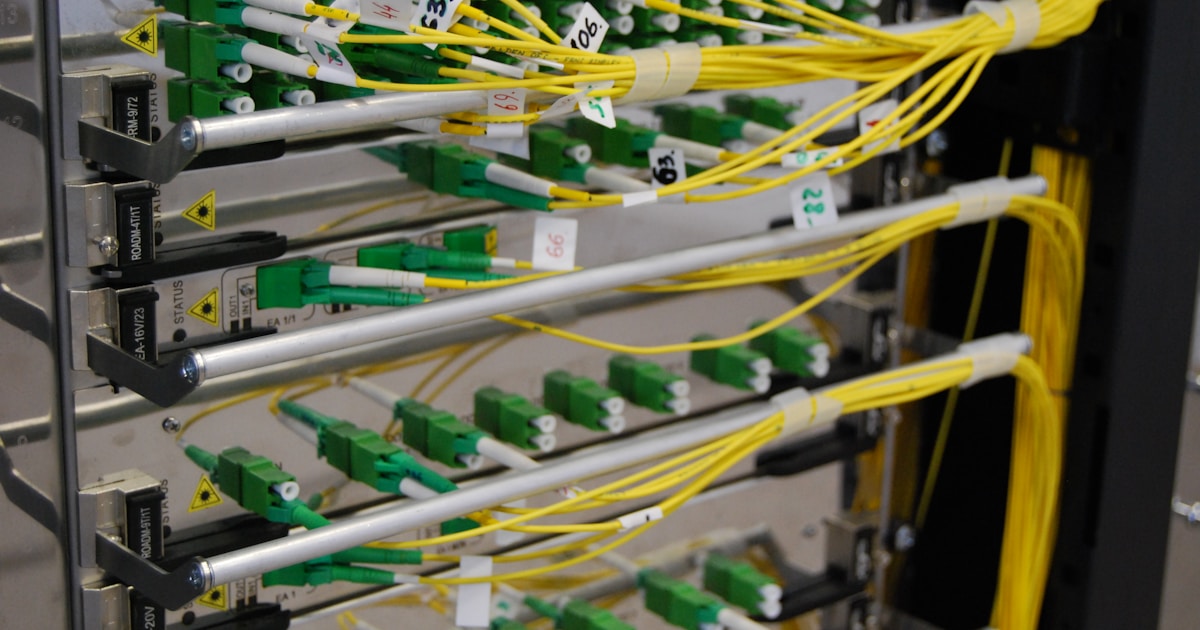
The EOI platform is POET’s pitch to be the merchant alternative to in-house
silicon-photonics programs at Intel,
hyperscalers,
and Broadcom. It uses wafer-level alignment of laser, modulator, and detector dies onto
a common interposer, which the company argues eliminates the per-unit active alignment
step that has been a bottleneck for high-volume photonics manufacturing.
For a company whose Q1 2026 revenue was $503,389 — yes, with a comma in
thousands, not millions — a confirmed $50M initial PO is a category-shifting
event. POET’s
SEC filings reflect a business that has been pre-revenue at scale for years; this is
the first commercial framework with a dollar figure that could meaningfully change the
financial model.
The $400M raise: terms, dilution, and why the tape balked
One day later, on Thursday morning, POET disclosed a $400 million registered direct
offering to a single institutional investor:
| Offering term | Value |
|---|---|
| Gross proceeds | $400,000,000 |
| Common shares issued | 19,047,620 |
| Combined share + warrant price | $21.00 |
| Warrants issued (1-for-1) | 19,047,620 |
| Warrant exercise price | $26.15 |
| Warrant term | 3 years |
| Expected closing | May 18, 2026 |
On the surface, the combined $21 price is a slight premium to the May 14 closing
price of $20.57 — not a busted deal. The problem is the share count. POET reported
roughly 89.8 million shares outstanding heading into the offering,
based on public market-cap data
trackers.[2]
Issuing 19.05 million new common shares amounts to roughly 21% immediate
dilution. The matching warrant tranche, if exercised, would lift fully-diluted
share count to roughly 128 million — a potential 42% increase from the
pre-deal base.
For a name that opened the week trading around $20 with a market cap under $2
billion, that is a textbook overhang. Holders who marked up the stock on the Lumilens
news watched it get marked back down by the share-count math less than 24 hours later.
Why the AI optics narrative still matters
Even after Thursday’s drawdown, POET is still up sharply from its 52-week low of
$3.87, reflecting how forcefully the market has been re-rating optical-networking
suppliers as AI cluster sizes balloon. The thesis is plumbing: as Nvidia and AMD pack
more accelerators per rack and stitch them together at 800G and 1.6T per port, the
optical layer becomes both the bottleneck and the cost driver. Hyperscalers want a
second source.
That structural demand is what gives the Lumilens framework its weight. A
$500-million-over-time ceiling is still well below the multi-billion-dollar transceiver
orders that Coherent and Lumentum win
from hyperscalers each year, but it would be transformative for a sub-$2 billion
market-cap supplier whose trailing-twelve-month revenue is in the single-digit millions.
The financial reality check
The other side of the trade is that POET’s 2026 P&L is still pre-product. In
its Q1 2026 disclosures, the company reported:
- Revenue of $503,389, roughly triple the year-earlier quarter,
but on a base near zero. - A net loss of approximately $12.3 million, with operating
expenses dominated by engineering and customer-qualification work.
That is why management arguably had to raise. Funding a 12–24-month
manufacturing ramp to deliver a $50 million initial PO requires working capital well
beyond what current revenue can support. The trade-off is the one the tape just priced:
21% immediate dilution today buys the cash needed to chase the framework opportunity.
Whether shareholders ultimately come out ahead depends entirely on whether the Lumilens
order book actually flows.
What to watch next
- May 18, 2026 — expected closing of the offering. Watch for
the final 6-K or 8-K to confirm investor identity and any sidecar covenants. - The first delivery milestone against the $50 million Lumilens PO. The market
rewards revenue recognition on photonics names; it discounts framework numbers. - Operating-expense run-rate in Q2 2026. With ~$400 million in fresh cash, the
bigger risk now shifts from solvency to capital efficiency.
For now, POET is a clean case study in why “deal announcement” and
“equity offering” should never share a 48-hour window if management can
avoid it.
Sources
- Yahoo Finance — Most Active Stocks (May 15, 2026)
- Google Finance — POET Technologies quote page
- CompaniesMarketCap — POET shares outstanding and market cap history
- SEC EDGAR — POET Technologies filings
Disclosure: It is for informational purposes only and is not investment advice.