
Nokia (NYSE: NOK) jumped 11.69% on May 13, 2026 to close at $14.71, the Finnish telecom-equipment giant’s strongest one-day move in years and a near-touch of its 52-week high of $14.83. The catalyst was a fresh push into “agentic AI” for telecom networks — software that lets the network operate itself, with fewer humans in the loop. After-hours trading carried the stock further to $15.39, up another 4.62%.
The move handed Nokia a market capitalization of roughly $82.1 billion and outran the day’s tech rally by a wide margin. The Technology Select Sector benchmark added about 1.8% on Wednesday, while the S&P 500 closed at 7,444.25, up 0.58%, and the VIX ticked up barely a hair to 17.39 — a calm tape against a single-name eruption.
What Drove the Pop: Agentic AI Hits the Network Layer
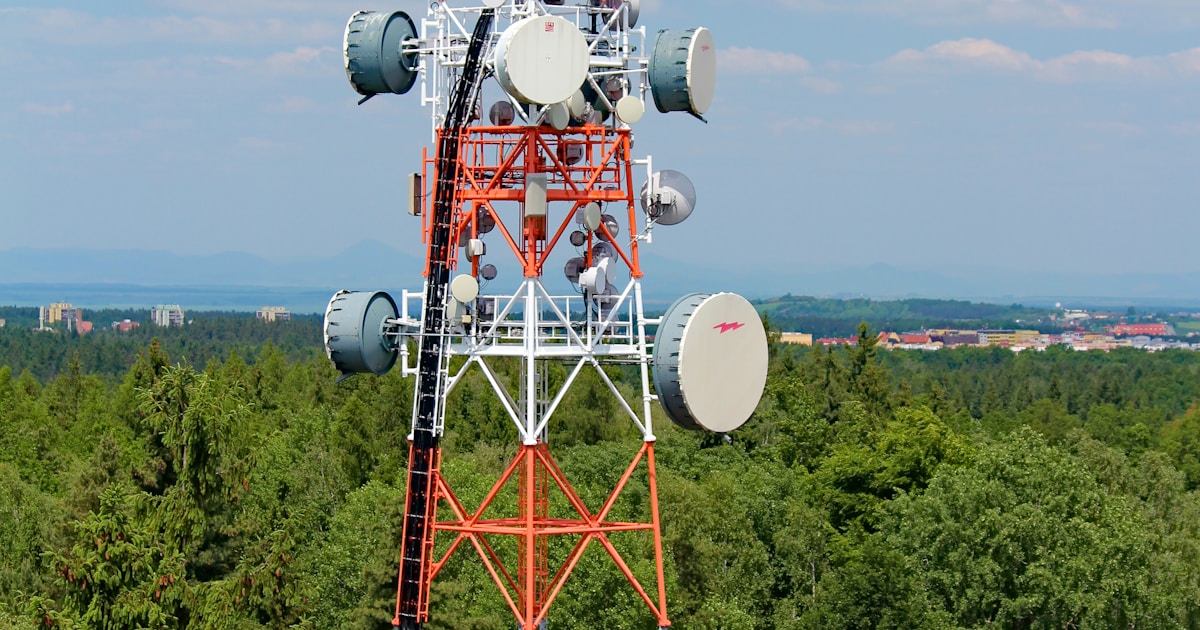
Nokia’s announcement centered on new AI features for its network platforms, framed by the company and tracked by analysts as a “telecom agentic AI solution.” Agentic AI — in the broader sense of autonomous systems that pursue goals, use tools, and take multi-step actions with varying degrees of autonomy — is the hottest acronym in enterprise software in 2026. Until now, it has mostly meant chatbots that book travel or draft code. Nokia is trying to extend the same idea down into the radio access network and the IP/optical layer underneath it, where carriers spend tens of billions a year on equipment and where downtime is measured in seconds, not days.
The pitch resonates because carriers are under brutal cost pressure. 5G has been deployed; revenue from it has not arrived. Operating-expense reduction is the only obvious lever, and labor — network operations centers, manual configuration, fault triage — is the single largest item. An AI agent that can plan and execute a network change, verify it, and roll it back when something breaks does not need to fully replace human engineers to pay for itself; cutting routine ticket volume by even a fraction shows up immediately in carrier free cash flow.
One Stock, Two Companies
Nokia is in the middle of a multiyear pivot. The brand most consumers associate with feature phones was actually founded in 1865 in Tampere, Finland, sold its mobile devices business to Microsoft in 2014, and now operates as a telecom-infrastructure vendor headquartered in Espoo. CEO Justin Hotard, who took over in March 2025 from Pekka Lundmark, has spent his first year recasting the company as an AI-native network supplier rather than a 5G-equipment vendor that bolts AI on top.
Today’s investor reaction suggests that pivot is starting to be priced in. The trailing P/E of 91.94, paired with a 1.11% dividend yield, is a profile that looks more like a high-growth software story than a slow-growing infrastructure stock. Wall Street has not caught up: the consensus one-year price target sits at $12.51, well below the $14.71 close and roughly 19% under the after-hours mark. When a stock prints above the average sell-side target, either the analysts move or the price does.
| Metric | Nokia (NOK) | Ericsson (ERIC) |
|---|---|---|
| Closing price, May 13, 2026 | $14.71 | $12.53 |
| Day’s % change | +11.69% | +1.62% |
| Market capitalization | ~$82.1B | ~$41.7B |
| 52-week range | $4.00 – $14.83 | n/a in source |
| Trailing P/E | 91.94 | n/a in source |
| Dividend yield | 1.11% | n/a in source |
| Consensus 1-year target | $12.51 | n/a in source |
| AI catalyst, May 13, 2026 | “Telecom agentic AI” for networks | T-Mobile 5G Advanced AI RAN |
Ericsson Is Not Standing Still
The day’s tape also showed why Nokia’s move stood out: the closest pure-play competitor, Ericsson (Nasdaq: ERIC), climbed only 1.62% to $12.53 and a market cap of about $41.7 billion. Ericsson too has been pushing AI into the network — including a recent rollout described in Yahoo Finance data as a “world first with Ericsson AI RAN innovation” deployed on T-Mobile’s 5G Advanced network. The market interpreted Nokia’s announcement as a step further: not just AI-assisted radio software but agent-style automation that spans the operational stack.
The bigger picture is that the telecom-equipment market is a four-way race. Per Wikipedia’s industry summary, Nokia’s primary competitors are Ericsson, Huawei, Cisco, and ZTE. U.S. and many European carriers cannot buy from Huawei or ZTE on national-security grounds, which leaves Nokia and Ericsson splitting most of the addressable Western 5G market between them. Any product that genuinely shifts share — or that lets one vendor sell more software-rich services per dollar of hardware — gets priced quickly. That is what May 13 looked like.
The Bull Case — And Where It Breaks
The bull case writes itself. Carriers globally face flat-to-falling average revenue per user, the macro backdrop is keeping rates higher for longer, and every operator from AT&T to Deutsche Telekom is signalling that AI-driven operations efficiency is a board-level priority. If Nokia’s agentic AI software gets adopted broadly, the company sells higher-margin software attach into an installed base of physical network gear it already supplies. That is the textbook playbook Cisco ran in the 2000s and Arista is running now — turning a hardware franchise into a recurring-revenue franchise.
The bear case is also worth respecting. The trailing P/E near 92 implies investors are paying for an outcome that has not yet shown up in earnings. The 52-week low of $4.00 is a reminder that this is a stock that has lived through long, painful stretches of irrelevance. “Agentic” branding is everywhere in 2026; differentiating one vendor’s claim from another’s will require actual deployments at large carriers with measurable opex savings. None of that arrives in a single quarter.
What to Watch Next
Three checkpoints will tell investors whether May 13 was a re-rating or a one-day squeeze. First, named operator customers for the agentic AI product — ideally tier-one carriers, ideally with disclosed scope. Second, the next earnings call, where investors will look for Nokia to quantify what portion of network-platform revenue is software-and-services versus equipment. Third, sell-side response: with the consensus target at $12.51, either upward revisions follow this announcement or the stock has to digest a gap between price and ratings. The action in extended hours, with NOK pushing through $15, suggests the market expects analysts to move.
For now, Nokia has done what Big Tech learned in the last AI cycle: rename your roadmap to fit the moment, and the multiple expands first. Whether the cash flows follow is the question that will define the next four quarters.
Sources
- Yahoo Finance — Nokia (NOK) quote, price, key statistics, May 13, 2026 close
- Yahoo Finance — Ericsson (ERIC) quote, May 13, 2026 close
- Yahoo Finance — S&P 500 (^GSPC), May 13, 2026 close
- Yahoo Finance — CBOE Volatility Index (^VIX), May 13, 2026 close
- Wikipedia — Nokia Corporation (founding, HQ, CEO, business segments, competitors)
- Wikipedia — AI agent / agentic AI definition
Disclosure: It is for informational purposes only and is not investment advice.