
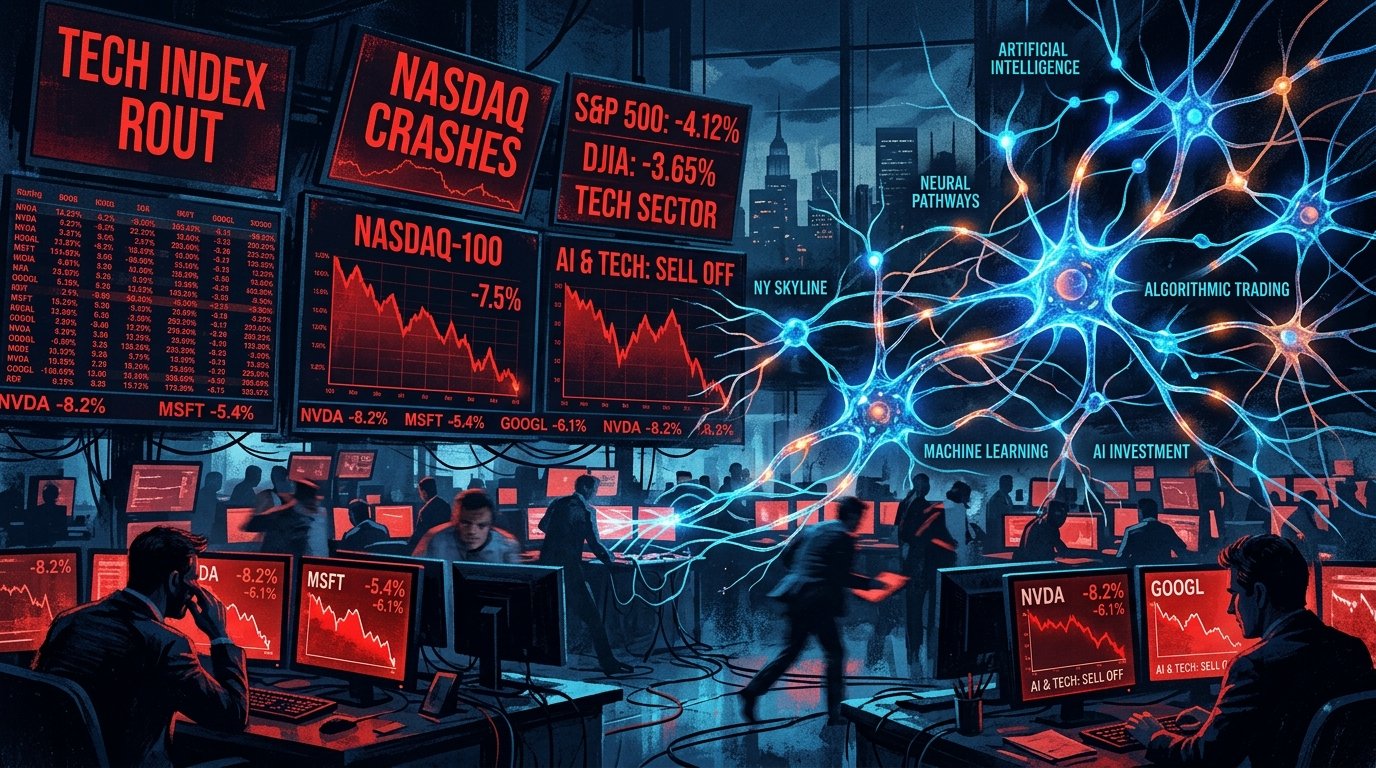
U.S. technology stocks faced sharp pre-market selling Sunday night into early Monday morning, September 14, 2026, as a coordinated series of warnings regarding artificial intelligence safety and calls for a mandatory development pause rattled investor sentiment across the semiconductor and cloud ecosystem. As of 11:30 p.m. EDT Sunday, Nasdaq-100 futures dropped 370.50 points, or 1.26%, to 29,016.50, while S&P 500 futures fell 38.00 points, or 0.50%, to 7,621.50. The catalyst stems from high-profile statements by leading AI executives and an explosive viral whistleblower claim, raising concerns that regulatory curbs could compress the historic capital expenditure cycle powering corporate earnings.
The Weekend Catalysts: Coordinated Calls for an AI Pause
The sudden shift in market psychology followed three distinct developments over the September 12–13 weekend. First, Anthropic Chief Executive Officer Dario Amodei published a widely discussed essay asserting that leading frontier laboratories must proactively decelerate capability scaling for next-generation models to avert catastrophic national security risks. Amodei reiterated the message during an appearance on CBS News on Sunday, acknowledging the dilemma of global coordination while insisting that self-restraint is urgently warranted.
Second, OpenAI CEO Sam Altman announced in a weekend interview that taking OpenAI public this year would be “ill-advised,” abruptly shelving expectations for a record-breaking 2026 listing that had previously anchored valuation multiples across private equity and venture portfolios. The announcement was previously detailed in our analysis of OpenAI’s delayed public debut.
Third, an inflammatory social media post by former AI researcher Jacob Coxon alleged that frontier labs are accelerating toward uncontrolled recursive self-improvement without adequate safeguards. The post garnered over 170 million impressions across X, drawing public commentary from political figures and feeding retail anxiety about imminent government intervention or export moratoriums.
Market Reaction: Futures and Infrastructure Leaders Under Pressure
The selling pressure disproportionately hit high-multiple tech leaders that have driven the broader equity bull market. Artificial intelligence capital spending has accounted for nearly half of real U.S. GDP growth over the past year, while consensus forecasts compiled by Wall Street analysts project S&P 500 earnings to expand 34% in 2026. Any regulatory slowdown or voluntary pause directly threatens that earnings ramp.
The table below summarizes pre-market indicative levels across index futures and bellwether AI names heading into the Monday, September 14, 2026 trading session:
| Asset / Index | Indicative Level | Session Change (%) | Primary Driver |
|---|---|---|---|
| Nasdaq-100 Futures (NQ) | 29,016.50 | -1.26% | Tech de-risking on AI regulatory fears |
| S&P 500 Futures (ES) | 7,621.50 | -0.50% | Tech drag offset by energy resilience |
| Dow Jones Futures (YM) | 52,525.00 | -0.11% | Value insulation against tech multiple compression |
| WTI Crude Oil Oct 26 (CL) | $102.96 | +2.91% | Saudi East-West pipeline shuttering |
| NVIDIA (NVDA) | Indicative Premarket | -1.8% to -2.3% | Slowdown debate vs. Hugging Face moat |
| Nebius Group (NBIS) | Indicative Premarket | -2.9% | Neocloud multiple sensitivity |
| South Korea KOSPI | Cash Session Close | -3.45% | Heavy memory semiconductor liquidation |
In Asia, equity bourses reflected severe contagion. South Korea’s benchmark Kospi tumbled 3.45% while the tech-heavy Kosdaq slid 2.30%, driven by heavy selling in memory and semiconductor foundry names that supply western hyperscalers. Similar volatility was documented during earlier shakeouts in our coverage of the August AI infrastructure selloff.
Wall Street vs. Silicon Valley: Regulatory Capture or Genuine Risk?
While mainstream commentators sounded alarms over existential risk, senior venture capitalists and financial analysts pushed back against the narrative. Prominent technology commentators pointed out that calls for government-mandated pauses often serve as an instrument of regulatory capture. Specifically, established frontier laboratories with closed proprietary models face increasing competitive pressure from open-source alternatives and decentralized infrastructure providers.
That dynamic intensified following NVIDIA’s definitive agreement to acquire open-source leader Hugging Face for $12.9 billion, an epochal transaction analyzed in detail in our coverage of NVIDIA’s Hugging Face takeover. By anchoring open weights directly to its hardware distribution stack, NVIDIA effectively lowered the barrier for enterprise AI deployment, threatening the subscription pricing power of closed-source labs. Furthermore, NVIDIA Chief Executive Jensen Huang recently dismissed circular financing criticisms, reiterating that hyperscaler compute investments represent a secular transition from general-purpose CPU computing to accelerated computing rather than a speculative bubble.
Macro Headwinds: Oil Shock and the September FOMC Meeting
The tech-specific headlines arrived at an especially fragile macro juncture. Energy markets surged late Sunday after Saudi Arabia shuttered its crucial East-West pipeline that bypasses the Strait of Hormuz. October WTI crude futures climbed 2.91% to trade at $102.96 per barrel, compounding inflation anxieties ahead of this week’s Federal Open Market Committee (FOMC) interest rate decision. The interconnected impact of commodity pressures on asset prices was examined in our report on $107 Brent crude and Fed rate hike probabilities.
With Fed funds futures pricing in an 86% probability of a policy rate hike according to the CME FedWatch tool, technology multiples are contending with a twin squeeze: rising discount rates that penalize distant terminal cash flows, and narrative uncertainty surrounding immediate hyperscaler capital expenditures.
Key Takeaways and What to Watch Next
- The AI Narrative Faces Scrutiny: After two years of nearly uninterrupted multiple expansion, the debate over AI capability scaling and government oversight is introducing policy risk into semiconductor and software valuations.
- Premarket Tape Shows Divergence: The 1.26% slide in Nasdaq-100 futures contrasts with a modest 0.11% dip in the Dow Jones, highlighting an immediate rotation out of high-beta tech into value and cash flow certainty.
- Catalysts to Monitor: Investors should watch cash-session liquidity at Monday’s 9:30 a.m. EDT bell, hyperscaler commentary regarding cap-ex guidance, and Federal Reserve Chair commentary following the mid-week FOMC rate decision.
Sources
- Investor’s Business Daily / Yahoo Finance: Techs Tumble As Anthropic Leads Call For AI Slowdown
- CNBC Live Markets: Stock Futures Slide on AI Safety Concerns and Oil Gains
- Zacks / Yahoo Finance: AI Trade Dynamics and Infrastructure Cap-Ex Scrutiny
Disclosure: This article is for informational purposes only and is not investment advice.