
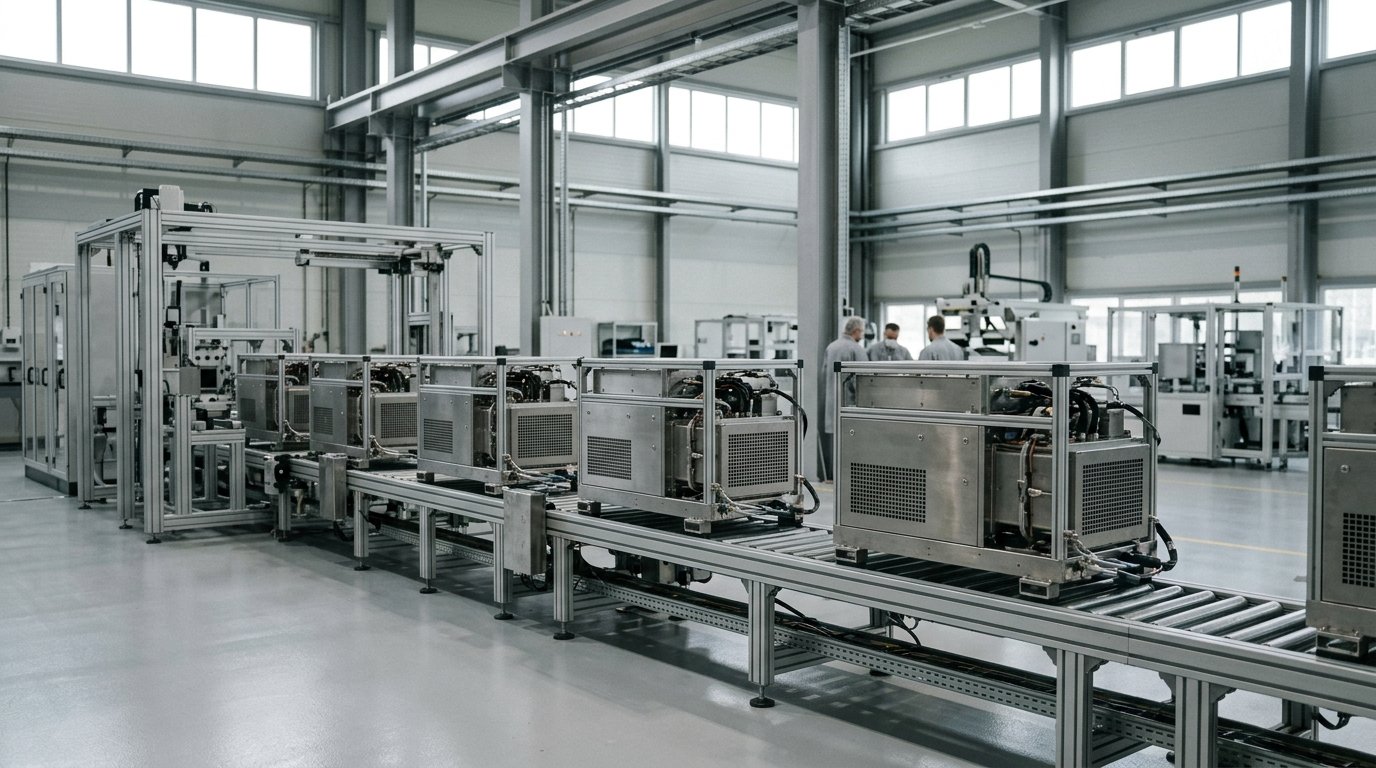
Bloom Energy shares surged 11.7% during regular trading on Tuesday, September 29, 2026, rebounding after the clean power manufacturer secured a new 158,000-square-foot industrial facility lease on Encyclopedia Circle in Fremont, California. The site acquisition substantially expands the company’s Silicon Valley operational footprint, advancing its strategic target to double annual solid-oxide fuel cell manufacturing capacity from 1 gigawatt (GW) to 2 GW by year-end 2026 as grid connection bottlenecks push hyperscalers toward on-site electrical generation.
Key Takeaways
- Manufacturing Expansion: Bloom Energy secured a 158,000-square-foot facility in Fremont, California, supplementing its existing 164,000-square-foot footprint and creating capacity to meet expanding artificial intelligence data center supply agreements.
- Capacity Milestone: The plant expansion accelerates management’s roadmap to scale annual production capacity to 2 GW by the close of 2026, addressing multi-year utility queue delays for utility-scale power.
- Financial Turnaround: In its Form 10-Q filing with the U.S. Securities and Exchange Commission for the quarterly period ended June 30, 2026, Bloom Energy reported second-quarter revenue of $1,065.37 million and operating income of $182.24 million, supported by $2,666.86 million in cash and cash equivalents against $2,470.70 million in recourse debt.
Fremont Footprint and the 2 GW Manufacturing Target
The newly leased 158,000-square-foot building in Fremont nearly doubles Bloom Energy’s existing 164,000-square-foot manufacturing footprint in the city. The City of Fremont confirmed that the facility will house automated module assembly and high-density power testing systems, creating hundreds of specialized green-manufacturing jobs in the East Bay.
Bloom Energy’s solid-oxide fuel cell technology produces electricity via an electrochemical reaction rather than combustion, allowing commercial clients to deploy localized baseload power in modular blocks. For data center operators facing three- to seven-year interconnection delays from regional electric utilities, on-site fuel cells offer a behind-the-meter primary power source that can be energized in months rather than years.
In its regulatory disclosures, the company affirmed its ongoing capital allocation strategy: “We expect to continue to make capital investments to expand production capacity at our manufacturing facilities in Fremont, California and Delmarva, Delaware.” The filing added that “These investments, which include the purchase of new equipment and tenant improvements, are part of our strategic plan to continually increase capacity to meet orders and customer deliver requirements.”
Q2 2026 Financial Turnaround and Balance Sheet Health
Tuesday’s stock rally follows a volatile multi-week stretch for energy infrastructure names. However, the fundamental backdrop has strengthened markedly over the past two quarters. In the second quarter of 2026, Bloom Energy crossed $1 billion in quarterly sales for the first time in corporate history, driven by commercial shipments to hyperscale data center projects.
| Financial Metric (in thousands) | Three Months Ended June 30, 2026 | Three Months Ended June 30, 2025 | Year-over-Year Change |
|---|---|---|---|
| Product Revenue | $935,413 | $296,611 | +215.4% |
| Total Revenue | $1,065,365 | $401,242 | +165.5% |
| Gross Profit | $355,572 | $107,123 | +231.9% |
| Operating Income (Loss) | $182,237 | $(3,503) | Turnaround to Profit |
| Net Income (Loss) Attributable to Common | $196,290 | $(42,619) | Turnaround to Profit |
| Diluted Earnings (Loss) Per Share | $0.62 | $(0.18) | +$0.80 |
| Cash and Cash Equivalents | $2,666,859 | $2,454,108* | +$212.75M |
Bloom’s liquidity position provides essential flexibility as it tools up the new Fremont facility. As of June 30, 2026, the company held $2,666.86 million in cash and cash equivalents, compared with $2,454.11 million as of December 31, 2025. Total assets reached $5,628.40 million. On the liability side, Bloom reported $2,470.70 million in long-term recourse debt, current recourse debt of $4.69 million, and operating lease liabilities totaling $125.82 million ($23.09 million current and $102.73 million non-current).
The company also took active steps to refinance and simplify its balance sheet. According to Note 16 of the filing, “The redemption of the 3.0 % Green Notes due June 2028 was completed on July 10, 2026.” Additionally, the filing revealed that “In May 2026, we made a $ 50.0 million payment to acquire contractual rights under an option arrangement.” Those rights were assigned in July 2026 to a Brookfield vehicle, which agreed to reimburse the $50.0 million upon project acquisition, highlighting Bloom’s role as an equipment manufacturer rather than a long-term asset holder.
Hyperscaler Partnerships and S&P 500 Index Inclusion
The factory expansion comes on the heels of major institutional catalysts. On September 21, 2026, Bloom Energy officially joined the S&P 500 index, triggering mandatory portfolio rebalancing among passive index trackers and benchmarked institutional mutual funds. That addition cemented Bloom’s evolution from an emerging clean-tech manufacturer into a core component of U.S. electrical infrastructure.
Earlier this year, Brookfield boosted its AI infrastructure partnership with Bloom Energy to $25 billion, committing capital to deploy on-site generation clusters across global cloud corridors. That expansion built upon Oracle’s 2.8 GW fuel cell deployment agreement to provide dedicated power for enterprise AI training facilities.
The critical value proposition of behind-the-meter fuel cells was highlighted earlier this month when Oracle invoked force majeure on its $165 billion Project Jupiter AI site due to utility substation delays. While traditional utility interconnections remain stalled by regional grid queues, on-site fuel cells give hyperscalers predictable generation capacity that can scale alongside server installations. Readers examining broader market dynamics can review ECMSource’s market coverage hub.
Risks and Catalysts to Watch
While the Fremont facility expansion strengthens Bloom Energy’s delivery capabilities, several operational and market risks remain:
- Factory Ramp Execution: Commissioning 158,000 square feet of advanced assembly systems requires substantial capital expenditure and flawless supply chain coordination. Any delay in tool installation could bottleneck deliveries scheduled for early 2027.
- Natural Gas Feedstock Dependencies: Although Bloom’s solid-oxide fuel cells can operate on hydrogen or biogas blends, current commercial data center deployments rely primarily on natural gas distribution pipelines, leaving customers subject to localized gas pipeline permitting and commodity price cycles.
- Hyperscaler Project Timelines: Because Bloom sells modular power blocks for massive data center clusters, customer schedule adjustments or construction delays at remote site locations could shift revenue timing between reporting periods.
Investors will look to Bloom Energy’s upcoming third-quarter 2026 financial report in late October for initial capital expenditure updates on the Fremont leasehold buildout and updated delivery schedules for 2027 capacity commitments.
Sources
- U.S. Securities and Exchange Commission: Bloom Energy Corp. Form 10-Q for the Quarterly Period Ended June 30, 2026 (CIK 0001664703)
- City of Fremont Economic Development Department: Advanced Manufacturing Facility Lease and Industrial Footprint Notice (September 2026)
- S&P Dow Jones Indices: S&P 500 Quarterly Rebalancing Announcement (Effective September 21, 2026)
Disclosure: This article is for informational purposes only and is not investment advice.